

Human ANP32A protein (Recombinant) (His-Tag) (STJP016852)
SPECIFICATIONS
HostE.coli
ImmunogenHuman
General Information
| Short Description | Recombinant-Human ANP32A-His-Tag protein was developed from e.coli and has a target region of His-Tag. For use in research applications. |
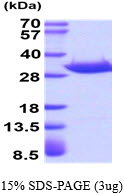
| Applications | SDS-PAGE |
| Host | E.coli |
| Note | STRICTLY FOR FURTHER SCIENTIFIC RESEARCH USE ONLY (RUO). MUST NOT TO BE USED IN DIAGNOSTIC OR THERAPEUTIC APPLICATIONS. |
Product Properties
| Concentration | 0.5 mg/mL |
| Formulation | Liquid in 20mM Tris-HCl buffer (pH 8.0) containing 10% Glycerol, 1mM DTT, 100mM NaCl, 0.1mM PMSF |
| Storage Instruction | For short term storage, keep at +2C to +8C for up to 1 week. For long term storage, aliquot and store at-20C, and avoid repeat freeze-thaw cycles. |
Target Information
| Gene Symbol | ANP32A |
| Gene ID | 8125 |
| Uniprot ID | AN32A_HUMAN |
| Accession Number | NP_006296 |
| Immunogen | Human |
| Immunogen Region | 1-249aa |
| Immunogen Sequence | MGSSHHHHHH SSGLVPRGSH MEMGRRIHLE LRNRTPSDVK ELVLDNSRSN EGKLEGLTDE FEELEFLSTI NVGLTSIANL PKLNKLKKLE LSDNRVSGGL EVLAEKCPNL THLNLSGNKI KDLSTIEPLK KLENLKSLDL FNCEVTNLND YRENVFKLLP QLTYLDGYDR DDKEAPDSDA EGYVEGLDDE EEDEDEEEYD EDAQVVEDEE DEDEEEEGEE EDVSGEEE |
Additional Info
| Tissue Specificity | Expressed in all tissues tested. Highly expressed in kidney and skeletal muscle, moderate levels of expression in brain, placenta and pancreas, and weakly expressed in lung. Found in all regions of the brain examined (amygdala, caudate nucleus, corpus callosum, hippocampus and thalamus), with highest levels in amygdala. |
| Post Translational Modifications | Phosphorylated on serine residues, at least in part by casein kinase 2/CK2. The N-terminus is blocked. Some glutamate residues are glycylated by TTLL8. This modification occurs exclusively on glutamate residues and results in a glycine chain on the gamma-carboxyl group. |
| Function | Multifunctional protein that is involved in the regulation of many processes including tumor suppression, apoptosis, cell cycle progression or transcription. Promotes apoptosis by favouring the activation of caspase-9/CASP9 and allowing apoptosome formation. In addition, plays a role in the modulation of histone acetylation and transcription as part of the INHAT (inhibitor of histone acetyltransferases) complex. Inhibits the histone-acetyltranferase activity of EP300/CREBBP (CREB-binding protein) and EP300/CREBBP-associated factor by histone masking. Preferentially binds to unmodified histone H3 and sterically inhibiting its acetylation and phosphorylation leading to cell growth inhibition. Participates in other biochemical processes such as regulation of mRNA nuclear-to-cytoplasmic translocation and stability by its association with ELAVL1 (Hu-antigen R). Plays a role in E4F1-mediated transcriptional repression as well as inhibition of protein phosphatase 2A. (Microbial infection) Plays an essential role in influenza A, B and C viral genome replication. Mechanistically, mediates the assembly of the viral replicase asymmetric dimers composed of PB1, PB2 and PA via its N-terminal region. Also plays an essential role in foamy virus mRNA export from the nucleus. |
| Protein Name | Acidic Leucine-Rich Nuclear Phosphoprotein 32 Family Member AAcidic Nuclear Phosphoprotein Pp32Pp32Leucine-Rich Acidic Nuclear ProteinLanpMapmodulinPotent Heat-Stable Protein Phosphatase 2a Inhibitor I1pp2aPutative Hla-Dr-Associated Protein IPhapi |
| Database Links | Reactome: R-HSA-450520 |
| Cellular Localisation | NucleusCytoplasmEndoplasmic ReticulumTranslocates To The Cytoplasm During The Process Of NeuritogenesisShuttles Between Nucleus And Cytoplasm |
| Alternative Protein Names | Acidic Leucine-Rich Nuclear Phosphoprotein 32 Family Member A proteinAcidic Nuclear Phosphoprotein Pp32 proteinPp32 proteinLeucine-Rich Acidic Nuclear Protein proteinLanp proteinMapmodulin proteinPotent Heat-Stable Protein Phosphatase 2a Inhibitor I1pp2a proteinPutative Hla-Dr-Associated Protein I proteinPhapi proteinANP32A proteinC15orf1 proteinLANP proteinMAPM proteinPHAP1 protein |
Information sourced from Uniprot.org