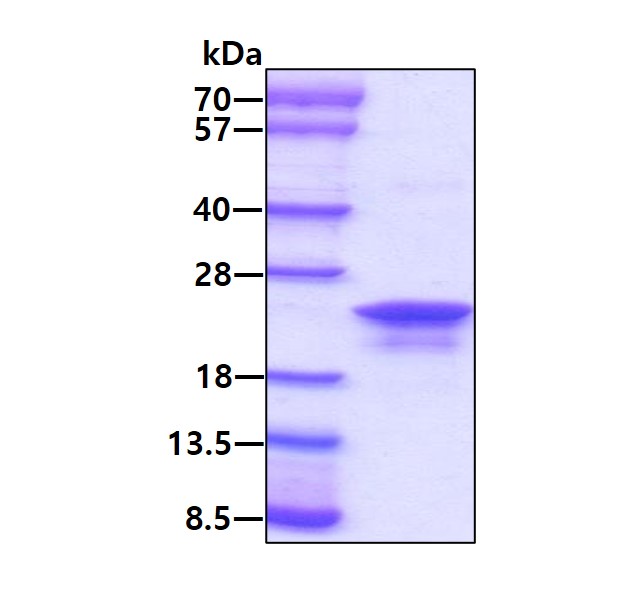
| Tissue Specificity | Expressed strongly in trachea, lung, stomach, colon, prostate and small intestine. Expressed weakly in pituitary gland, salivary gland, mammary gland, bladder, appendix, ovary, fetal lung, uterus, pancreas, kidney, fetal kidney, testis, placenta, thyroid gland and in estrogen receptor (ER)-positive breast cancer cell lines. |
| Function | Required for MUC2 post-transcriptional synthesis and secretion. May play a role in the production of mucus by intestinal cells. Proto-oncogene that may play a role in cell migration, cell differentiation and cell growth. Promotes cell adhesion. |
| Protein Name | Anterior Gradient Protein 2 HomologAg-2Hag-2Hpc8Secreted Cement Gland Protein Xag-2 Homolog |
| Database Links | |
| Cellular Localisation | SecretedEndoplasmic Reticulum |
| Alternative Protein Names | Anterior Gradient Protein 2 Homolog proteinAg-2 proteinHag-2 proteinHpc8 proteinSecreted Cement Gland Protein Xag-2 Homolog proteinAGR2 proteinAG2 proteinUNQ515 proteinPRO1030 protein |
Information sourced from Uniprot.org