

Human Activin A protein (Recombinant) (His-Tag) (STJP019066)
SPECIFICATIONS
HostE.coli
ImmunogenHuman
General Information
| Short Description | Recombinant-Human Activin A-His-Tag protein was developed from e.coli and has a target region of His-Tag. For use in research applications. |
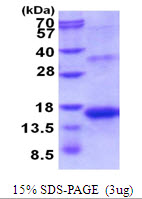
| Applications | SDS-PAGE/Denatured |
| Host | E.coli |
| Note | STRICTLY FOR FURTHER SCIENTIFIC RESEARCH USE ONLY (RUO). MUST NOT TO BE USED IN DIAGNOSTIC OR THERAPEUTIC APPLICATIONS. |
Product Properties
| Concentration | 1 mg/mL |
| Formulation | Liquid in 20mM Tris-HCl buffer (pH 8.0) containing 10% Glycerol |
| Storage Instruction | For short term storage, keep at +2C to +8C for up to 1 week. For long term storage, aliquot and store at-20C, and avoid repeat freeze-thaw cycles. |
Target Information
| Gene Symbol | INHBA |
| Gene ID | 3624 |
| Uniprot ID | INHBA_HUMAN |
| Accession Number | NP_002183 |
| Immunogen | Human |
| Immunogen Region | 311-426aa |
| Immunogen Sequence |
Additional Info
| Function | Inhibins/activins are involved in regulating a number of diverse functions such as hypothalamic and pituitary hormone secretion, gonadal hormone secretion, germ cell development and maturation, erythroid differentiation, insulin secretion, nerve cell survival, embryonic axial development or bone growth, depending on their subunit composition. Activin A is a homodimer of INHBA that plays a role in several essential biological processes including embryonic development, stem cell maintenance and differentiation, haematopoiesis, cell proliferation and tissue fibrosis. Signals through type I (such as ACVR1B or ACVR1C) and type II receptors (such as ACVR2A, ACVR2B or BMPR2) which, upon ligand binding, phosphorylate SMAD2 and SMAD3 intracellular signaling mediators that form a complex with SMAD4, translocate to the nucleus and modulate gene expression. Can also activate alternative non-canonical intracellular signaling pathways including the p38 MAPK, extracellular signal-regulated kinases 1/2 (ERK1/2) and c-Jun N-terminal kinases (JNKs) to modulate cell migration and differentiation. Alternatively, promotes osteoblastic differentiation via ACVRL1-SMAD1/5/9 pathway. In addition, can engage the type I receptor ACVR1 to form an ACVR1-activin A-type II receptor non-signaling complex (NSC) that renders receptors unavailable for engagement with BMPs, hence resulting in an apparent inhibition of ACVR1-mediated BMP signaling. Inhibin A is a dimer of alpha/INHA and beta-A/INHBA that functions as a feedback regulator in the hypothalamic-pituitary-gonadal (HPG) axis. Inhibits the secretion of FSH from the anterior pituitary gland by acting on pituitary gonadotrope cells. Antagonizes activin A by binding to the proteoglycan, betaglycan, and forming a stable complex with and, thereby, sequestering type II activin receptors while excluding type I receptor. |
| Protein Name | Inhibin Beta A ChainActivin Beta-A ChainErythroid Differentiation ProteinEdf |
| Database Links | Reactome: R-HSA-1502540Reactome: R-HSA-201451Reactome: R-HSA-209822Reactome: R-HSA-2473224Reactome: R-HSA-9839406 |
| Cellular Localisation | Secreted |
| Alternative Protein Names | Inhibin Beta A Chain proteinActivin Beta-A Chain proteinErythroid Differentiation Protein proteinEdf proteinINHBA protein |
Information sourced from Uniprot.org