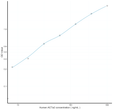
This ACTa2 Sandwich ELISA Kit, Ready-To-Use is an in-vitro enzyme-linked immunosorbent assay for the measurement of samples in human tissue homogenates, cell lysates or other biological fluids..
Applications
ELISA
Reactivity
Human
Sensitivity
3.16ng/mL
Detection Limit
7.81-500ng/mL
Note
STRICTLY FOR FURTHER SCIENTIFIC RESEARCH USE ONLY (RUO). MUST NOT TO BE USED IN DIAGNOSTIC OR THERAPEUTIC APPLICATIONS.
Product Properties
Storage Instruction
The whole kit may be stored at-20°C for up to 12 months from receipt. An unopened kit may be stored in the fridge at 2-8°C for up to 6 months. Once opened store individual kit contents according to components table provided with the kit.
tissue homogenates, cell lysates or other biological fluids.
Additional Info
Tissue Specificity
Post Translational Modifications
Oxidation of Met-46 and Met-49 by MICALs (MICAL1, MICAL2 or MICAL3) to form methionine sulfoxide promotes actin filament depolymerization. MICAL1 and MICAL2 produce the (R)-S-oxide form. The (R)-S-oxide form is reverted by MSRB1 and MSRB2, which promotes actin repolymerization. Monomethylation at Lys-86 (K84me1) regulates actin-myosin interaction and actomyosin-dependent processes. Demethylation by ALKBH4 is required for maintaining actomyosin dynamics supporting normal cleavage furrow ingression during cytokinesis and cell migration. Methylated at His-75 by SETD3. Actin, aortic smooth muscle, intermediate form: N-terminal cleavage of acetylated cysteine of intermediate muscle actin by ACTMAP. (Microbial infection) Monomeric actin is cross-linked by V.cholerae toxins RtxA and VgrG1 in case of infection: bacterial toxins mediate the cross-link between Lys-52 of one monomer and Glu-272 of another actin monomer, resulting in formation of highly toxic actin oligomers that cause cell rounding. The toxin can be highly efficient at very low concentrations by acting on formin homology family proteins: toxic actin oligomers bind with high affinity to formins and adversely affect both nucleation and elongation abilities of formins, causing their potent inhibition in both profilin-dependent and independent manners.
Function
Actins are highly conserved proteins that are involved in various types of cell motility and are ubiquitously expressed in all eukaryotic cells.
Protein Name
Actin - Aortic Smooth MuscleAlpha-Actin-2Cell Growth-Inhibiting Gene 46 Protein Cleaved Into - Actin - Aortic Smooth Muscle - Intermediate Form