

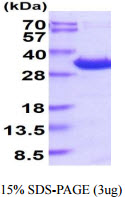

Human 14-3-3 epsilon protein (Recombinant) (His-Tag) (STJP019328)
SPECIFICATIONS
HostE.coli
ImmunogenHuman
General Information
| Short Description | Recombinant-Human 14-3-3 epsilon-His-Tag protein was developed from e.coli and has a target region of His-Tag. For use in research applications. |
| Applications | SDS-PAGE |
| Host | E.coli |
| Note | STRICTLY FOR FURTHER SCIENTIFIC RESEARCH USE ONLY (RUO). MUST NOT TO BE USED IN DIAGNOSTIC OR THERAPEUTIC APPLICATIONS. |
Product Properties
| Concentration | 1 mg/mL |
| Formulation | Liquid in phosphate-Buffered Saline (pH 7.4) containing 1mM DTT, 10% Glycerol |
| Storage Instruction | For short term storage, keep at +2C to +8C for up to 1 week. For long term storage, aliquot and store at-20C, and avoid repeat freeze-thaw cycles. |
Target Information
| Gene Symbol | YWHAE |
| Gene ID | 7531 |
| Uniprot ID | 1433E_HUMAN |
| Accession Number | NP_006752 |
| Immunogen | Human |
| Immunogen Region | 1-255aa |
| Immunogen Sequence | MGSSHHHHHH SSGLVPRGSH MDDREDLVYQ AKLAEQAERY DEMVESMKKV AGMDVELTVE ERNLLSVAYK NVIGARRASW RIISSIEQKE ENKGGEDKLK MIREYRQMVE TELKLICCDI LDVLDKHLIP AANTGESKVF YYKMKGDYHR YLAEFATGND RKEAAENSLV AYKAASDIAM TELPPTHPIR LGLALNFSVF YYEILNSPDR ACRLAKAAFD DAIAELDT |
Additional Info
| Post Translational Modifications | (Microbial infection) Cleaved by poliovirus protease 3C, leading to disruption of the interaction with RIGI. |
| Function | Adapter protein implicated in the regulation of a large spectrum of both general and specialized signaling pathways. Binds to a large number of partners, usually by recognition of a phosphoserine or phosphothreonine motif. Binding generally results in the modulation of the activity of the binding partner. Positively regulates phosphorylated protein HSF1 nuclear export to the cytoplasm. Plays a positive role in the antiviral signaling pathway upstream of TBK1 via interaction with RIGI. Mechanistically, directs RIGI redistribution from the cytosol to mitochondrial associated membranes where it mediates MAVS-dependent innate immune signaling during viral infection. Plays a role in proliferation inhibition and cell cycle arrest by exporting HNRNPC from the nucleus to the cytoplasm to be degraded by ubiquitination. |
| Protein Name | 14-3-3 Protein Epsilon14-3-3e |
| Database Links | Reactome: R-HSA-111447Reactome: R-HSA-1445148Reactome: R-HSA-2028269Reactome: R-HSA-205025Reactome: R-HSA-2565942Reactome: R-HSA-3371453Reactome: R-HSA-3371511Reactome: R-HSA-380259Reactome: R-HSA-380270Reactome: R-HSA-380284Reactome: R-HSA-380320Reactome: R-HSA-5620912Reactome: R-HSA-5625740Reactome: R-HSA-5628897Reactome: R-HSA-75035Reactome: R-HSA-8854518Reactome: R-HSA-8862803Reactome: R-HSA-8876198Reactome: R-HSA-9735871Reactome: R-HSA-9755779Reactome: R-HSA-9856649 |
| Cellular Localisation | NucleusCytoplasmMelanosomeIdentified By Mass Spectrometry In Melanosome Fractions From Stage I To Stage Iv |
| Alternative Protein Names | 14-3-3 Protein Epsilon protein14-3-3e proteinYWHAE protein |
Information sourced from Uniprot.org