

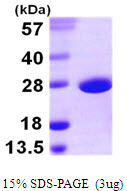

e.coli sodA protein (Recombinant) (His-Tag) (STJP017173)
SPECIFICATIONS
HostE.coli
ImmunogenE.coli
General Information
| Short Description | Recombinant-e.coli sodA-His-Tag protein was developed from e.coli and has a target region of His-Tag. For use in research applications. |
| Applications | Enzyme Activity/SDS-PAGE |
| Host | E.coli |
| Note | STRICTLY FOR FURTHER SCIENTIFIC RESEARCH USE ONLY (RUO). MUST NOT TO BE USED IN DIAGNOSTIC OR THERAPEUTIC APPLICATIONS. |
Product Properties
| Concentration | 1 mg/mL |
| Formulation | Liquid in 20mM Tris-HCl buffer (pH 8.0) containing 1mM DTT, 10% Glycerol, 0.1M NaCl |
| Storage Instruction | For short term storage, keep at +2C to +8C for up to 1 week. For long term storage, aliquot and store at-20C, and avoid repeat freeze-thaw cycles. |
| Immunoreactivity | Specific activity is > 300unit/mg, in which one unit will inhibit the rate of reduction of cytochrome c by 50% in a coupled system, using xanthine and Xanthine oxidase at pH 7.5 at 25C. |
Target Information
| Accession Number | NP_418344 |
| Immunogen | E.coli |
| Immunogen Region | 1-206aa |
| Immunogen Sequence | MGSSHHHHHH SSGLVPRGSH MSYTLPSLPY AYDALEPHFD KQTMEIHHTK HHQTYVNNAN AALESLPEFA NLPVEELITK LDQLPADKKT VLRNNAGGHA NHSLFWKGLK KGTTLQGDLK AAIERDFGSV DNFKAEFEKA AASRFGSGWA WLVLKGDKLA VVSTANQDSP LMGEAISGAS GFPIMGLDVW EHAYYLKFQN RRPDYIKEFW NVVNWDEAAA RFAAKK |
Additional Info
| Background | Superoxide dismutase, Mn, also known as sodA, is a member of the iron/manganese superoxide dismutase family. SodA destroys radicals which are normally produced within the cells and which are toxic to biological systems. It works by catalyzing the dismutation of the superoxide radical O2-to O2 and H2O2, which are then metabolized to H2O and O2 by catalase and glutathione peroxidase. Recombinant E. coli sodA protein, fused to His-tag at N-terminus, was expressed in E. coli and purified by using conventional chromatography techniques. |
Information sourced from Uniprot.org