

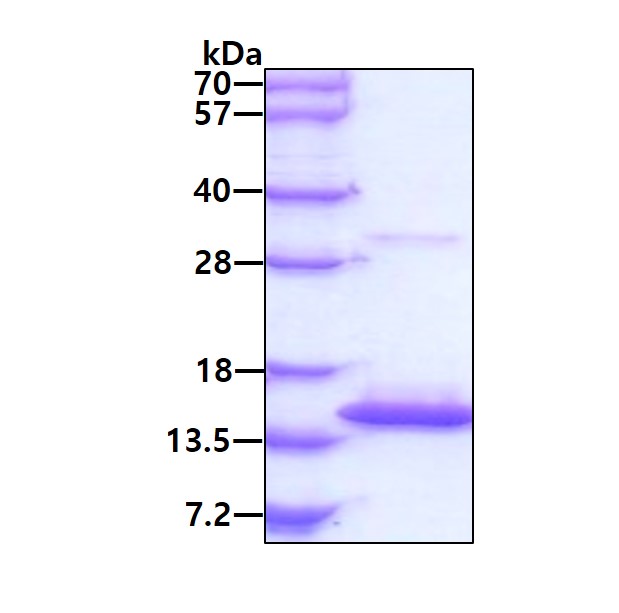

E.coli rnpA protein (Recombinant) (No-Tag) (STJP019487)
SPECIFICATIONS
HostE.coli
ImmunogenE.coli
General Information
| Short Description | Recombinant-E.coli rnpA-No-Tag protein was developed from e.coli and has a target region of No-Tag. For use in research applications. |
| Applications | SDS-PAGE |
| Host | E.coli |
| Note | STRICTLY FOR FURTHER SCIENTIFIC RESEARCH USE ONLY (RUO). MUST NOT TO BE USED IN DIAGNOSTIC OR THERAPEUTIC APPLICATIONS. |
Product Properties
| Concentration | 0.25 mg/mL |
| Formulation | Liquid Phosphate-Buffered Saline (pH 7.4) containing 10% Glycerol |
| Storage Instruction | For short term storage, keep at +2C to +8C for up to 1 week. For long term storage, aliquot and store at-20C, and avoid repeat freeze-thaw cycles. |
| Endotoxin | < 1 EU per 1ug of protein (determined by LAL method) |
Target Information
| Accession Number | NP_418159.1 |
| Immunogen | E.coli |
| Immunogen Region | 1-119aa |
| Immunogen Sequence | MVKLAFPREL RLLTPSQFTF VFQQPQRAGT PQITILGRLN SLGHPRIGLT VAKKNVRRAH ERNRIKRLTR ESFRLRQHEL PAMDFVVVAK KGVADLDNRA LSEALEKLWR RHCRLARGS |
Additional Info
| Background | rnpA, also known as Rnase P protein, is an essential enzyme consisting of the C5 protein (encoded by rnpA) and the catalytic M1 RNA (encoded by rnpB) subunits. rnpA is ribonucleoprotein that catalyzes the removal of the 50-leader elements of precursor tRNAs and generates the mature 50-end of tRNAs. This step is essential for the formation of functional tRNA molecules in bacteria, archaea and eukarya. More importantly, it has recently been demonstrated that RNase P is required for the endonucleolytic separation of certain polycistronic tRNA transcripts such as valV valW, leuQ leuP leuV and secG leuU. Thus, it was hypothesized that the essential function of RNase P might be related to the complete absence of a particular tRNAthat was dependent on the enzyme for initial separation from polycistronic transcripts. Recombinant E.coli rnpA, was expressed in E. coli and purified by using conventional chromatography techniques. |
Information sourced from Uniprot.org