
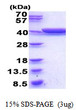
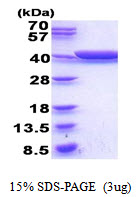

e.coli gldA protein (Recombinant) (His-Tag) (STJP019194)
SPECIFICATIONS
HostE.coli
ImmunogenE.coli
General Information
| Short Description | Recombinant-e.coli gldA-His-Tag protein was developed from e.coli and has a target region of His-Tag. For use in research applications. |
| Applications | Enzyme Activity/SDS-PAGE |
| Host | E.coli |
| Note | STRICTLY FOR FURTHER SCIENTIFIC RESEARCH USE ONLY (RUO). MUST NOT TO BE USED IN DIAGNOSTIC OR THERAPEUTIC APPLICATIONS. |
Product Properties
| Concentration | 1 mg/mL |
| Formulation | Liquid in phosphate-Buffered Saline (pH 7.4) 10% Glycerol |
| Storage Instruction | For short term storage, keep at +2C to +8C for up to 1 week. For long term storage, aliquot and store at-20C, and avoid repeat freeze-thaw cycles. |
| Immunoreactivity | Specific activity: > 14 Units/ml One unit will oxidize 1.0 umole of glycerol to dihydroxyacetone per minute at pH 8.0 at 25C |
Target Information
| Accession Number | NP_418380 |
| Immunogen | E.coli |
| Immunogen Region | 1-367aa |
| Immunogen Sequence | MGSSHHHHHH SSGLVPRGSH MGSMDRIIQS PGKYIQGADV INRLGEYLKP LAERWLVVGD KFVLGFAQST VEKSFKDAGL VVEIAPFGGE CSQNEIDRLR GIAETAQCGA ILGIGGGKTL DTAKALAHFM GVPVAIAPTI ASTDAPCSAL SVIYTDEGEF DRYLLLPNNP NMVIVDTKIV AGAPARLLAA GIGDALATWF EARACSRSGA TTMAGGKCTQ AALALAEL |
Additional Info
| Background | gldA catalyzes the NAD-dependent oxidation of glycerol to dihydroxyacetone (glycerone). This protein allows microorganisms to utilize glycerol as a source of carbon under anaerobic conditions. In E. coli, an important role of GldA is also likely to regulate the intracellular level of dihydroxyacetone by catalyzing the reverse reaction, i. e. the conversion of dihydroxyacetone into glycerol. gldA possesses a broad substrate specificity, since it is also able to oxidize 1, 2-propanediol and to reduce glycolaldehyde, methylglyoxal and hydroxyacetone into ethylene glycol, lactaldehyde and 1, 2-propanediol, respectively. Recombinant E. coli gldA protein, fused to His-tag at N-terminus, was expressed in E. coli and purified by using conventional chromatography techniques. |
Information sourced from Uniprot.org