

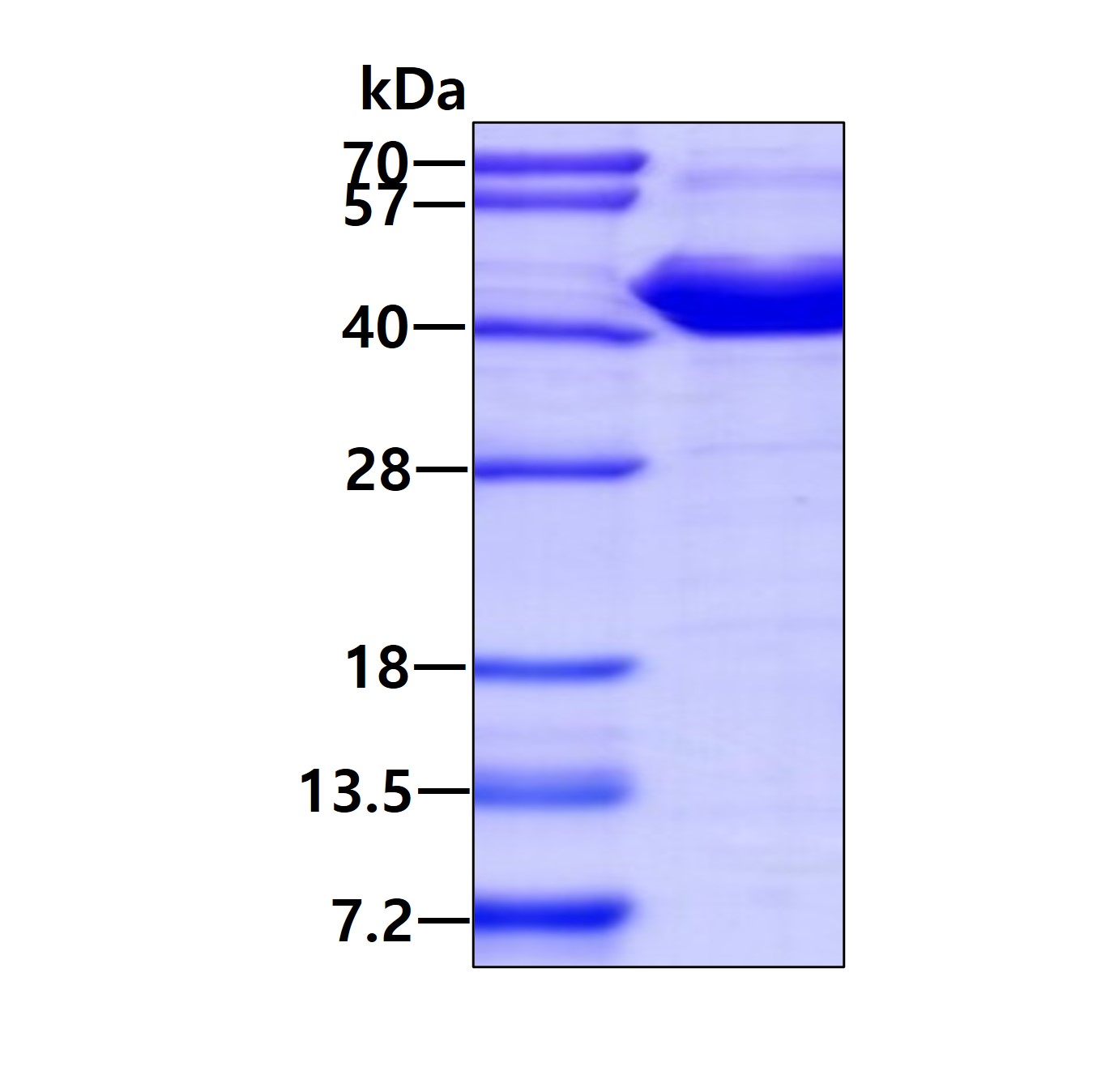

E.coli Dnak (1-384aa) protein (Recombinant) (No-Tag) (STJP019611)
SPECIFICATIONS
HostE.coli
ImmunogenE.coli
General Information
| Short Description | Recombinant-E.coli Dnak (1-384aa)-No-Tag protein was developed from e.coli and has a target region of No-Tag. For use in research applications. |
| Applications | SDS-PAGE |
| Host | E.coli |
| Note | STRICTLY FOR FURTHER SCIENTIFIC RESEARCH USE ONLY (RUO). MUST NOT TO BE USED IN DIAGNOSTIC OR THERAPEUTIC APPLICATIONS. |
Product Properties
| Concentration | 1 mg/mL |
| Formulation | Liquid in 25mM Tris-HCl buffer (pH 7.5) containing 100mM NaCl, 5mM DTT, 10%Glycerol |
| Storage Instruction | For short term storage, keep at +2C to +8C for up to 1 week. For long term storage, aliquot and store at-20C, and avoid repeat freeze-thaw cycles. |
Target Information
| Accession Number | NP_414555 |
| Immunogen | E.coli |
| Immunogen Region | 1-384aa |
| Immunogen Sequence | MGKIIGIDLG TTNSCVAIMD GTTPRVLENA EGDRTTPSII AYTQDGETLV GQPAKRQAVT NPQNTLFAIK RLIGRRFQDE EVQRDVSIMP FKIIAADNGD AWVEVKGQKM APPQISAEVL KKMKKTAEDY LGEPVTEAVI TVPAYFNDAQ RQATKDAGRI AGLEVKRIIN EPTAAALAYG LDKGTGNRTI AVYDLGGGTF DISIIEIDEV DGEKTFEVLA TNGDTHLG |
Additional Info
| Background | DnaK, originally identified for its DNA replication by bacteriophage lambda in E. coli is the bacterial hsp70 chaperone. This protein is involved in the folding and assembly of newly synthesized polypeptide chains and in preventing the aggregation of stress-denatured proteins. DnaK (amino acids1-384) is N-terminal ATPase domain and ATP bound to the ATPase domain induces a conformational change in the substrate binding domain (residues385-638). The protein coding region of the ATPase domain of DNAK (amino acids 1-384) was amplified by PCR and cloned into an E. coli expression vector. The ATPase domain of DNAK was overexpressed in E. coli and the recombinant protein was purified to apparent homogeneity by using conventional column chromatography techniques. |
Information sourced from Uniprot.org