

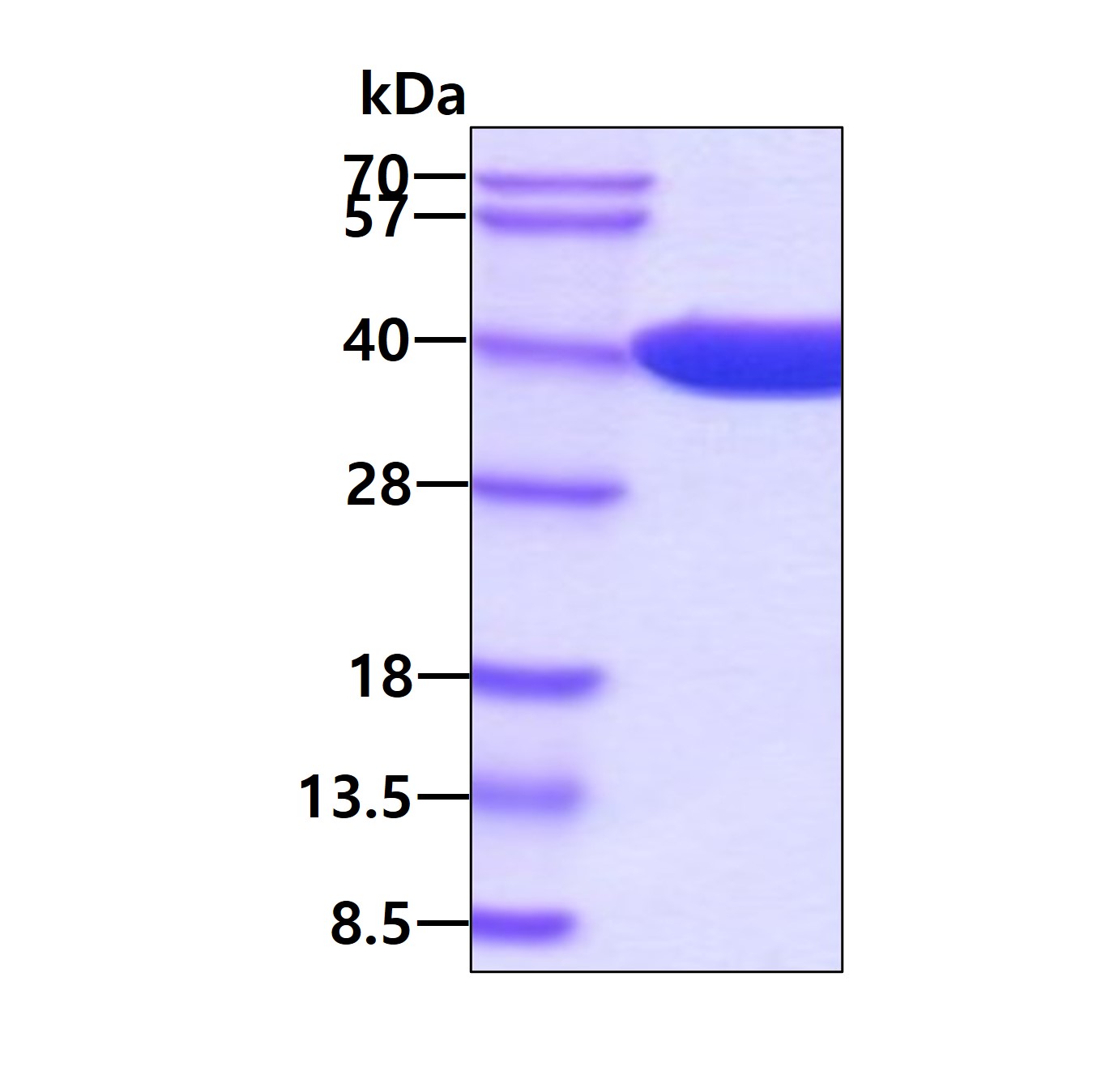

E.coli Beta-lactamase protein (Recombinant) (His-Tag) (STJP019326)
SPECIFICATIONS
HostE.coli
ImmunogenE.coli
General Information
| Short Description | Recombinant-E.coli Beta-lactamase-His-Tag protein was developed from e.coli and has a target region of His-Tag. For use in research applications. |
| Applications | SDS-PAGE/Enzyme Activity |
| Host | E.coli |
| Note | STRICTLY FOR FURTHER SCIENTIFIC RESEARCH USE ONLY (RUO). MUST NOT TO BE USED IN DIAGNOSTIC OR THERAPEUTIC APPLICATIONS. |
Product Properties
| Concentration | 1 mg/mL |
| Formulation | Liquid in 20mM Tris-HCl buffer (pH 8.0) containing 10% Glycerol |
| Storage Instruction | For short term storage, keep at +2C to +8C for up to 1 week. For long term storage, aliquot and store at-20C, and avoid repeat freeze-thaw cycles. |
| Immunoreactivity | Specific activity is >700unit/mg, in which One unit will hydrolyze 1.0umole of Nitrocefin per minute at pH 7.0 at 37C |
Target Information
| Accession Number | NP_418574 |
| Immunogen | E.coli |
| Immunogen Region | 20-377aa |
| Immunogen Sequence |
Additional Info
| Background | AmpC, also known as Beta-lactamase, is the most widespread resistance mechanism to beta-lactam antibiotics, such as the penicillins and the cephalosporins. These antibiotics have a common element in their molecular structure: a four-atom ring known as a beta-lactam. The lactamase enzyme breaks that ring open, deactivating the molecule s antibacterial properties. Recombinant E. coli beta-lactamase protein, fused to His-tag at N-terminus, was expressed in E. coli and purified by using conventional chromatography. |
Information sourced from Uniprot.org