

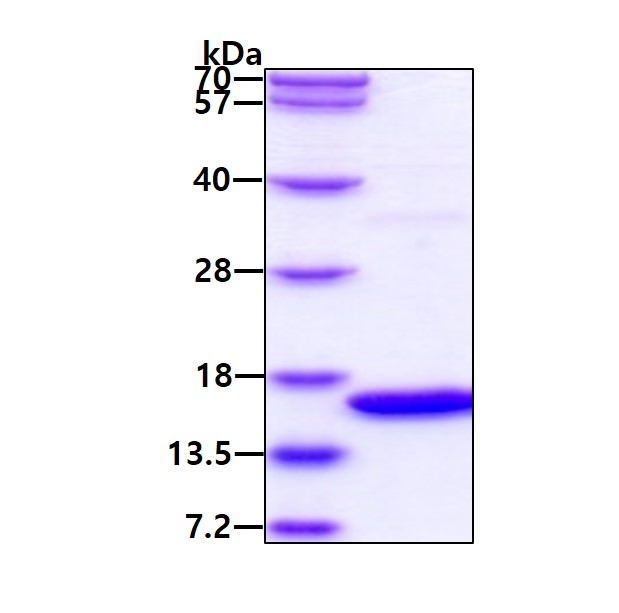

bovine TNF-alpha protein (Recombinant) (No-Tag) (STJP019503)
SPECIFICATIONS
HostE.coli
ImmunogenBovine
General Information
| Short Description | Recombinant-bovine TNF-alpha-No-Tag protein was developed from e.coli and has a target region of No-Tag. For use in research applications. |
| Applications | SDS-PAGE/Bioactivity |
| Host | E.coli |
| Note | STRICTLY FOR FURTHER SCIENTIFIC RESEARCH USE ONLY (RUO). MUST NOT TO BE USED IN DIAGNOSTIC OR THERAPEUTIC APPLICATIONS. |
Product Properties
| Concentration | 1 mg/mL |
| Formulation | Liquid in phosphate-Buffered Saline (pH 7.4) containing 10% Glycerol |
| Storage Instruction | For short term storage, keep at +2C to +8C for up to 1 week. For long term storage, aliquot and store at-20C, and avoid repeat freeze-thaw cycles. |
| Endotoxin | < 1 EU per 1ug of protein (determined by LAL method) |
| Immunoreactivity | Measured in a cytotoxicity assay using L-929 mouse fibroblast cells in the presence of the metabolic inhibitor actinomycin D. The ED50 range ≤ 15ng/ml. |
Target Information
| Accession Number | NP_776391 |
| Immunogen | Bovine |
| Immunogen Region | 78-234aa |
| Immunogen Sequence | MLRSSSQASS NKPVAHVVAD INSPGQLRWW DSYANALMAN GVKLEDNQLV VPADGLYLIY SQVLFRGQGC PSTPLFLTHT ISRIAVSYQT KVNILSAIKS PCHRETPEWA EAKPWYEPIY QGGVFQLEKG DRLSAEINLP DYLDYAESGQ VYFGIIAL |
Additional Info
| Background | TNF-alpha, also known as tumor necrosis factor, is the prototypic ligand of the TNF superfamily. It is a pleiotropic molecule that plays a central role in inflammation, apoptosis, and immune system development. This protein is produced by a wide variety of immune and epithelial cell types. It is assembled intracellularly to form a noncovalently linked homotrimer which is expressed on the cell surface. Cell surface TNF can induce the lysis of neighboring tumor cells and virus infected cells, and it can generate its own downstream cell signaling following ligation by soluble TNFR I. It also promotes inflammatory responses by inducing the activation of vascular endothelial cells and macrophages. Recombinant Bovine TNF-alpha was expressed in E. coli and purified by using conventional chromatography techniques. |
Information sourced from Uniprot.org