

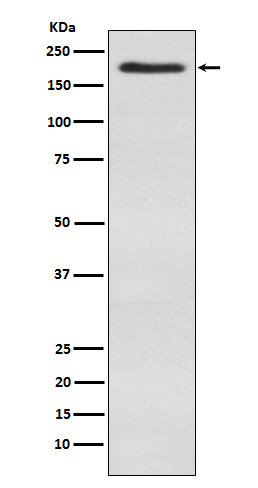

Anti-WSTF antibody [R06-4I5] (STJA0036878)
SPECIFICATIONS
ClonalityMonoclonal
HostRabbit
ConjugationUnconjugated
IsotypeIgG
ImmunogenA synthesized peptide derived from human WSTF
General Information
| Short Description | Rabbit monoclonal anti-WSTF for use in WB and FC in Human, Mouse and Rat samples. Datasheet included with dilution recommendations, and related reagents. |
| Applications | WB/FC |
| Host | Rabbit |
| Reactivity | Human/Mouse/Rat |
| Note | STRICTLY FOR FURTHER SCIENTIFIC RESEARCH USE ONLY (RUO). MUST NOT TO BE USED IN DIAGNOSTIC OR THERAPEUTIC APPLICATIONS. |
Product Properties
| Clonality | Monoclonal |
| Clone ID | R06-4I5 |
| Isotype | IgG |
| Conjugation | Unconjugated |
| Purification | Affinity Chromatography |
| Dilution Range | WB 1:500-1:1000FC 1:50-1:100 |
| Formulation | Rabbit IgG in phosphate buffered saline, pH 7.4, 150mM NaCl, 0.02% sodium azide and 50% glycerol. |
| Storage Instruction | Store at 4°C short term. Aliquot and store at-20°C long term. Avoid freeze/thaw cycles. |
Target Information
| Gene Symbol | BAZ1B |
| Gene ID | 9031 |
| Uniprot ID | BAZ1B_HUMAN |
| Immunogen | A synthesized peptide derived from human WSTF |
Additional Info
| Tissue Specificity | Ubiquitously expressed with high levels of expression in heart, brain, placenta, skeletal muscle and ovary. |
| Function | Atypical tyrosine-protein kinase that plays a central role in chromatin remodeling and acts as a transcription regulator. Involved in DNA damage response by phosphorylating 'Tyr-142' of histone H2AX (H2AXY142ph). H2AXY142ph plays a central role in DNA repair and acts as a mark that distinguishes between apoptotic and repair responses to genotoxic stress. Regulatory subunit of the ATP-dependent WICH-1 and WICH-5 ISWI chromatin remodeling complexes, which form ordered nucleosome arrays on chromatin and facilitate access to DNA during DNA-templated processes such as DNA replication, transcription, and repair. Both complexes regulate the spacing of nucleosomes along the chromatin and have the ability to slide mononucleosomes to the center of a DNA template. The WICH-1 ISWI chromatin remodeling complex has a lower ATP hydrolysis rate than the WICH-5 ISWI chromatin remodeling complex. The WICH-5 ISWI chromatin-remodeling complex regulates the transcription of various genes, has a role in RNA polymerase I transcription. Within the B-WICH complex has a role in RNA polymerase III transcription. Mediates the recruitment of the WICH-5 ISWI chromatin remodeling complex to replication foci during DNA replication. |
| Protein Name | Tyrosine-Protein Kinase Baz1bBromodomain Adjacent To Zinc Finger Domain Protein 1bWilliams Syndrome Transcription FactorWilliams-Beuren Syndrome Chromosomal Region 10 ProteinWilliams-Beuren Syndrome Chromosomal Region 9 ProteinHwalp2 |
| Database Links | Reactome: R-HSA-5250924Reactome: R-HSA-5693565 |
| Cellular Localisation | NucleusAccumulates In Pericentromeric Heterochromatin During ReplicationCo-Localizes With Pcna At Replication Foci During S PhaseCo-Localizes With Smarca5/Snf2h At Replication Foci During Late-S PhaseAlso Localizes To Replication Foci Independently Of Smarca5/Snf2h And PcnaLocalizes To Sites Of Dna Damage |
| Alternative Antibody Names | Anti-Tyrosine-Protein Kinase Baz1b antibodyAnti-Bromodomain Adjacent To Zinc Finger Domain Protein 1b antibodyAnti-Williams Syndrome Transcription Factor antibodyAnti-Williams-Beuren Syndrome Chromosomal Region 10 Protein antibodyAnti-Williams-Beuren Syndrome Chromosomal Region 9 Protein antibodyAnti-Hwalp2 antibodyAnti-BAZ1B antibodyAnti-WBSC10 antibodyAnti-WBSCR10 antibodyAnti-WBSCR9 antibodyAnti-WSTF antibody |
Information sourced from Uniprot.org