


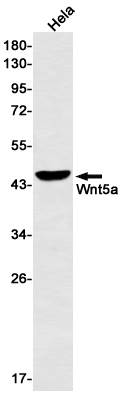
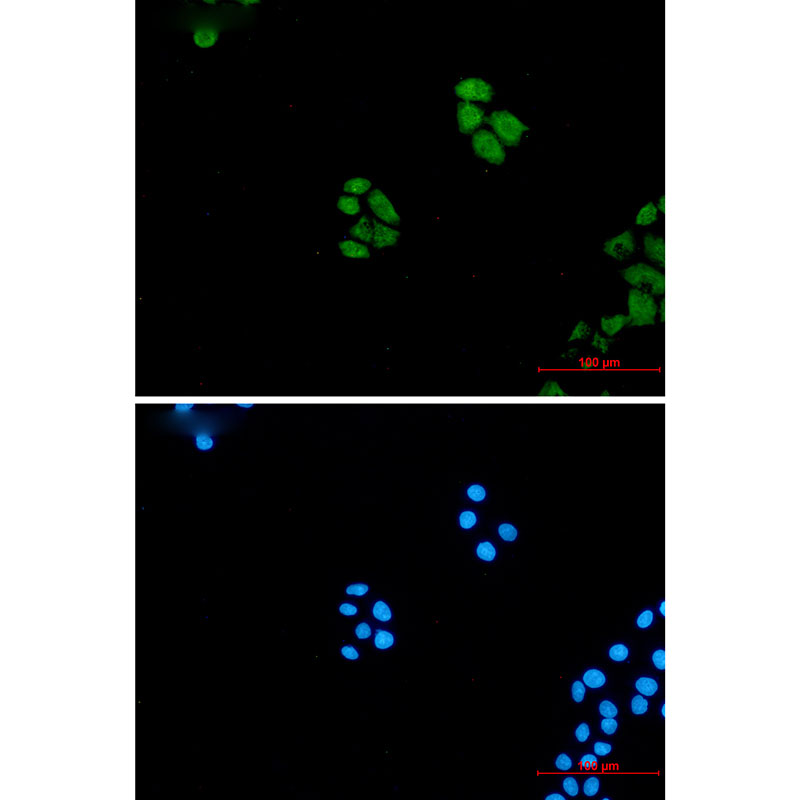

Anti-WNT5A antibody (340-354 aa) [R08-4A3] (STJA0012140)
SPECIFICATIONS
ClonalityMonoclonal
HostRabbit
ConjugationUnconjugated
IsotypeIgG
ImmunogenA synthetic peptide of human Wnt5a
General Information
| Short Description | Rabbit monoclonal anti-Wnt5a (340-354 aa) for use in WB, ICC and IF in Human samples. Datasheet included with dilution recommendations, and related reagents. |
| Applications | WB/ICC/IF |
| Host | Rabbit |
| Reactivity | Human |
| Note | STRICTLY FOR FURTHER SCIENTIFIC RESEARCH USE ONLY (RUO). MUST NOT TO BE USED IN DIAGNOSTIC OR THERAPEUTIC APPLICATIONS. |
Product Properties
| Clonality | Monoclonal |
| Clone ID | R08-4A3 |
| Isotype | IgG |
| Conjugation | Unconjugated |
| Concentration | 0.3 mg/mL |
| Purification | Affinity Purified |
| Dilution Range | WB 1:500-1:1000IF 1:50-1:200 |
| Formulation | 50mM Tris-Glycine (pH7.4) , 0.15M NaCl, 40% Glycerol, 0.01% Sodium azide and 0.05% BSA |
| Storage Instruction | Store at 4°C short term. Aliquot and store at-20°C long term. Avoid freeze/thaw cycles. |
Target Information
| Gene Symbol | WNT5A |
| Gene ID | 7474 |
| Uniprot ID | WNT5A_HUMAN |
| Immunogen | A synthetic peptide of human Wnt5a |
| Immunogen Region | 340-354 aa |
Additional Info
| Tissue Specificity | Expression is increased in differentiated thyroid carcinomas compared to normal thyroid tissue and anaplastic thyroid tumors where expression is low or undetectable. Expression is found in thyrocytes but not in stromal cells (at protein level). Detected in neonate heart and lung. |
| Post Translational Modifications | Glycosylation is necessary for secretion but not for activity. Palmitoleoylation is required for efficient binding to frizzled receptors. Depalmitoleoylation leads to Wnt signaling pathway inhibition. Proteolytic processing by TIKI1 and TIKI2 promotes oxidation and formation of large disulfide-bond oligomers, leading to inactivation of WNT5A. |
| Function | Ligand for members of the frizzled family of seven transmembrane receptors. Can activate or inhibit canonical Wnt signaling, depending on receptor context. In the presence of FZD4, activates beta-catenin signaling. In the presence of ROR2, inhibits the canonical Wnt pathway by promoting beta-catenin degradation through a GSK3-independent pathway which involves down-regulation of beta-catenin-induced reporter gene expression. Suppression of the canonical pathway allows chondrogenesis to occur and inhibits tumor formation. Stimulates cell migration. Decreases proliferation, migration, invasiveness and clonogenicity of carcinoma cells and may act as a tumor suppressor. Mediates motility of melanoma cells. Required during embryogenesis for extension of the primary anterior-posterior axis and for outgrowth of limbs and the genital tubercle. Inhibits type II collagen expression in chondrocytes. |
| Protein Name | Protein Wnt-5a |
| Database Links | Reactome: R-HSA-201681Reactome: R-HSA-3238698Reactome: R-HSA-373080Reactome: R-HSA-3772470Reactome: R-HSA-4086398Reactome: R-HSA-4086400Reactome: R-HSA-4608870Reactome: R-HSA-5099900Reactome: R-HSA-5140745Reactome: R-HSA-8856825Reactome: R-HSA-8856828Reactome: R-HSA-9673324 |
| Cellular Localisation | SecretedExtracellular SpaceExtracellular Matrix |
| Alternative Antibody Names | Anti-Protein Wnt-5a antibodyAnti-WNT5A antibody |
Information sourced from Uniprot.org