

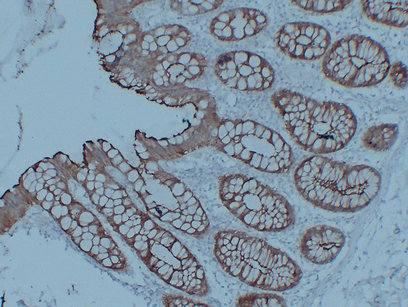

Anti-Villin antibody [3D10-9A4-4C9] (STJA0033479)
SPECIFICATIONS
ClonalityMonoclonal
HostMouse
ConjugationUnconjugated
IsotypeIgG2b
ImmunogenSynthesized peptide derived from human Villin
General Information
| Short Description | Mouse monoclonal anti-Villin for use in IHC-P in Human samples. Datasheet included with dilution recommendations, and related reagents. |
| Applications | IHC-P |
| Host | Mouse |
| Reactivity | Human |
| Note | STRICTLY FOR FURTHER SCIENTIFIC RESEARCH USE ONLY (RUO). MUST NOT TO BE USED IN DIAGNOSTIC OR THERAPEUTIC APPLICATIONS. |
Product Properties
| Clonality | Monoclonal |
| Clone ID | 3D10-9A4-4C9 |
| Isotype | IgG2b |
| Conjugation | Unconjugated |
| Concentration | 1 mg/mL |
| Purification | Affinity Chromatography |
| Dilution Range | IHC 1:100-1:500 |
| Formulation | Liquid in PBS containing 50% glycerol, 0.5% BSA and 0.02% sodium azide, pH 7.3. |
| Storage Instruction | Store at 4°C short term. Aliquot and store at-20°C long term. Avoid freeze/thaw cycles. |
Target Information
| Gene Symbol | VIL1 |
| Gene ID | 7429 |
| Uniprot ID | VILI_HUMAN |
| Immunogen | Synthesized peptide derived from human Villin |
Additional Info
| Tissue Specificity | Specifically expressed in epithelial cells. Major component of microvilli of intestinal epithelial cells and kidney proximal tubule cells. Expressed in canalicular microvilli of hepatocytes (at protein level). |
| Post Translational Modifications | Tyrosine phosphorylation is induced by epidermal growth factor (EGF) and stimulates cell migration. Phosphorylated on tyrosine residues by SRC. The unphosphorylated form increases the initial rate of actin-nucleating activity, whereas the tyrosine-phosphorylated form inhibits actin-nucleating activity, enhances actin-bundling activity and enhances actin-severing activity by reducing high Ca(2+) requirements. The tyrosine-phosphorylated form does not regulate actin-capping activity. Tyrosine phosphorylation is essential for cell migration: tyrosine phosphorylation sites in the N-terminus half regulate actin reorganization and cell morphology, whereas tyrosine phosphorylation sites in the C-terminus half regulate cell migration via interaction with PLCG1. |
| Function | Epithelial cell-specific Ca(2+)-regulated actin-modifying protein that modulates the reorganization of microvillar actin filaments. Plays a role in the actin nucleation, actin filament bundle assembly, actin filament capping and severing. Binds phosphatidylinositol 4,5-bisphosphate (PIP2) and lysophosphatidic acid (LPA).binds LPA with higher affinity than PIP2. Binding to LPA increases its phosphorylation by SRC and inhibits all actin-modifying activities. Binding to PIP2 inhibits actin-capping and -severing activities but enhances actin-bundling activity. Regulates the intestinal epithelial cell morphology, cell invasion, cell migration and apoptosis. Protects against apoptosis induced by dextran sodium sulfate (DSS) in the gastrointestinal epithelium. Appears to regulate cell death by maintaining mitochondrial integrity. Enhances hepatocyte growth factor (HGF)-induced epithelial cell motility, chemotaxis and wound repair. Upon S.flexneri cell infection, its actin-severing activity enhances actin-based motility of the bacteria and plays a role during the dissemination. |
| Protein Name | Villin-1 |
| Database Links | |
| Cellular Localisation | CytoplasmCytoskeletonCell ProjectionLamellipodiumRuffleMicrovillusFilopodium TipFilopodiumRelocalized In The Tip Of Cellular Protrusions And Filipodial Extensions Upon Infection With SFlexneri In Primary Intestinal Epithelial Cells (Iec) And In The Tail-Like Structures Forming The Actin Comets Of SFlexneriRedistributed To The Leading Edge Of Hepatocyte Growth Factor (Hgf)-Induced LamellipodiaRapidly Redistributed To Ruffles And Lamellipodia Structures In Response To AutotaxinLysophosphatidic Acid (Lpa) And Epidermal Growth Factor (Egf) Treatment |
| Alternative Antibody Names | Anti-Villin-1 antibodyAnti-VIL1 antibodyAnti-VIL antibody |
Information sourced from Uniprot.org