

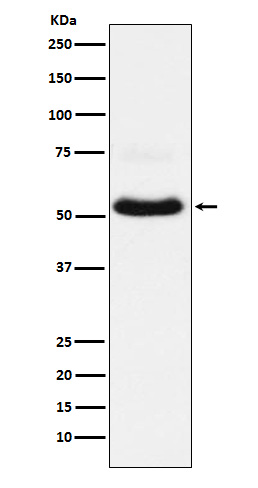

Anti-VGluT1 antibody [R06-4J6] (STJA0036694)
SPECIFICATIONS
ClonalityMonoclonal
HostRabbit
ConjugationUnconjugated
IsotypeIgG
ImmunogenA synthesized peptide derived from human VGluT1
General Information
| Short Description | Rabbit monoclonal anti-VGluT1 for use in WB in Human, Mouse and Rat samples. Datasheet included with dilution recommendations, and related reagents. |
| Applications | WB |
| Host | Rabbit |
| Reactivity | Human/Mouse/Rat |
| Note | STRICTLY FOR FURTHER SCIENTIFIC RESEARCH USE ONLY (RUO). MUST NOT TO BE USED IN DIAGNOSTIC OR THERAPEUTIC APPLICATIONS. |
Product Properties
| Clonality | Monoclonal |
| Clone ID | R06-4J6 |
| Isotype | IgG |
| Conjugation | Unconjugated |
| Purification | Affinity Chromatography |
| Dilution Range | WB 1:500-1:1000 |
| Formulation | Rabbit IgG in phosphate buffered saline, pH 7.4, 150mM NaCl, 0.02% sodium azide and 50% glycerol. |
| Storage Instruction | Store at 4°C short term. Aliquot and store at-20°C long term. Avoid freeze/thaw cycles. |
Target Information
| Gene Symbol | SLC17A7 |
| Gene ID | 57030 |
| Uniprot ID | VGLU1_HUMAN |
| Immunogen | A synthesized peptide derived from human VGluT1 |
Additional Info
| Tissue Specificity | Expressed in several regions of the brain including amygdala, cerebellum, cerebral cortex, hippocampus, frontal lobe, medulla, occipital lobe, putamen and temporal lobe. |
| Function | Multifunctional transporter that transports L-glutamate as well as multiple ions such as chloride, proton, potassium, sodium and phosphate. At the synaptic vesicle membrane, mainly functions as an uniporter which transports preferentially L-glutamate but also phosphate from the cytoplasm into synaptic vesicles at presynaptic nerve terminals of excitatory neural cells. The L-glutamate or phosphate uniporter activity is electrogenic and is driven by the proton electrochemical gradient, mainly by the electrical gradient established by the vacuolar H(+)-ATPase across the synaptic vesicle membrane. In addition, functions as a chloride channel that allows a chloride permeation through the synaptic vesicle membrane that affects the proton electrochemical gradient and promotes synaptic vesicles acidification. Moreover, may function as a K(+)/H(+) antiport allowing to maintain the electrical gradient and to decrease chemical gradient and therefore sustain vesicular glutamate uptake. The vesicular K(+)/H(+) antiport activity is electroneutral. At the plasma membrane, following exocytosis, functions as a symporter of Na(+) and phosphate from the extracellular space to the cytoplasm allowing synaptic phosphate homeostasis regulation. The symporter activity is driven by an inside negative membrane potential and is electrogenic. Is necessary for synaptic signaling of visual-evoked responses from photoreceptors. |
| Protein Name | Vesicular Glutamate Transporter 1Vglut1Brain-Specific Na(+-Dependent Inorganic Phosphate CotransporterSolute Carrier Family 17 Member 7 |
| Database Links | Reactome: R-HSA-210500Reactome: R-HSA-428643 |
| Cellular Localisation | Cytoplasmic VesicleSecretory VesicleSynaptic Vesicle MembraneCell MembraneMulti-Pass Membrane ProteinSynapseSynaptosome |
| Alternative Antibody Names | Anti-Vesicular Glutamate Transporter 1 antibodyAnti-Vglut1 antibodyAnti-Brain-Specific Na(+-Dependent Inorganic Phosphate Cotransporter antibodyAnti-Solute Carrier Family 17 Member 7 antibodyAnti-SLC17A7 antibodyAnti-BNPI antibodyAnti-VGLUT1 antibody |
Information sourced from Uniprot.org