
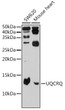


Anti-UQCRQ antibody (1-82) (STJ111914)
SPECIFICATIONS
ClonalityPolyclonal
HostRabbit
ConjugationUnconjugated
IsotypeIgG
General Information
| Short Description | Rabbit polyclonal UQCRQ (1-82) antibody for use in WB and ELISA in human and mouse samples. Datasheet included with dilution recommendations, and related reagents. |
| Applications | WB/ELISA |
| Host | Rabbit |
| Reactivity | Human/Mouse |
| Note | STRICTLY FOR FURTHER SCIENTIFIC RESEARCH USE ONLY (RUO). MUST NOT TO BE USED IN DIAGNOSTIC OR THERAPEUTIC APPLICATIONS. |
Product Properties
| Clonality | Polyclonal |
| Isotype | IgG |
| Conjugation | Unconjugated |
| Concentration | Lot specific |
| Purification | Affinity purification |
| Dilution Range | WB:1:500-1:2000ELISA:Recommended starting concentration is 1 Mu g/mL. Please optimize the concentration based on your specific assay requirements. |
| Formulation | PBS with 0.02% Sodium Azide, 50% Glycerol, pH 7.3. |
| Storage Instruction | Store at-20°C for up to 1 year from the date of receipt, and avoid repeat freeze-thaw cycles. |
Target Information
| Gene Symbol | UQCRQ |
| Gene ID | 27089 |
| Uniprot ID | QCR8_HUMAN |
| Immunogen Region | 1-82 |
| Immunogen Sequence | MGREFGNLTRMRHVISYSLS PFEQRAYPHVFTKGIPNVLR RIRESFFRVVPQFVVFYLIY TWGTEEFERSKRKNPAAYEN DK |
| Specificity | Recombinant fusion protein containing a sequence corresponding to amino acids 1-82 of human UQCRQ (NP_055217.2). |
Additional Info
| Function | Component of the ubiquinol-cytochrome c oxidoreductase, a multisubunit transmembrane complex that is part of the mitochondrial electron transport chain which drives oxidative phosphorylation. The respiratory chain contains 3 multisubunit complexes succinate dehydrogenase (complex II, CII), ubiquinol-cytochrome c oxidoreductase (cytochrome b-c1 complex, complex III, CIII) and cytochrome c oxidase (complex IV, CIV), that cooperate to transfer electrons derived from NADH and succinate to molecular oxygen, creating an electrochemical gradient over the inner membrane that drives transmembrane transport and the ATP synthase. The cytochrome b-c1 complex catalyzes electron transfer from ubiquinol to cytochrome c, linking this redox reaction to translocation of protons across the mitochondrial inner membrane, with protons being carried across the membrane as hydrogens on the quinol. In the process called Q cycle, 2 protons are consumed from the matrix, 4 protons are released into the intermembrane space and 2 electrons are passed to cytochrome c. |
| Protein Name | Cytochrome B-C1 Complex Subunit 8Complex Iii Subunit 8Complex Iii Subunit ViiiUbiquinol-Cytochrome C Reductase Complex 9.5 Kda ProteinUbiquinol-Cytochrome C Reductase Complex Ubiquinone-Binding Protein Qp-C |
| Database Links | Reactome: R-HSA-611105Reactome: R-HSA-9837999Reactome: R-HSA-9865881 |
| Cellular Localisation | Mitochondrion Inner MembraneSingle-Pass Membrane Protein |
| Alternative Antibody Names | Anti-Cytochrome B-C1 Complex Subunit 8 antibodyAnti-Complex Iii Subunit 8 antibodyAnti-Complex Iii Subunit Viii antibodyAnti-Ubiquinol-Cytochrome C Reductase Complex 9.5 Kda Protein antibodyAnti-Ubiquinol-Cytochrome C Reductase Complex Ubiquinone-Binding Protein Qp-C antibodyAnti-UQCRQ antibody |
Information sourced from Uniprot.org