

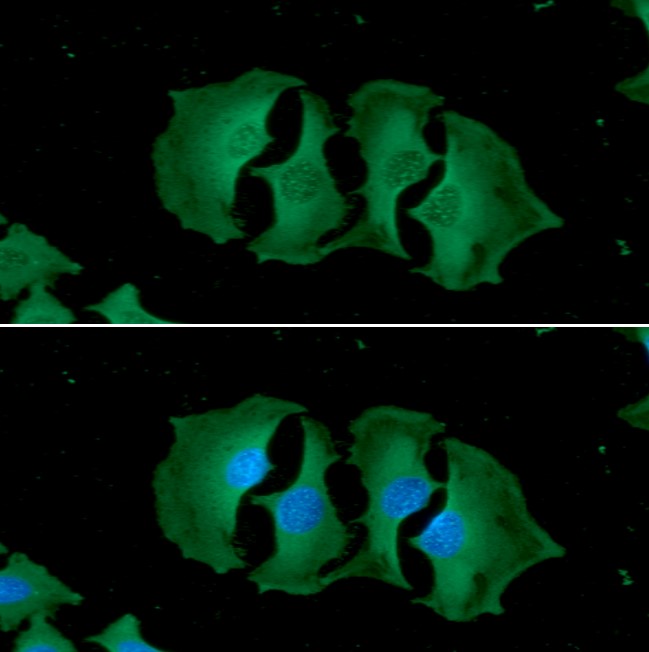


Anti-UNG antibody (1-313aa) [k1C12] (STJA0041985)
SPECIFICATIONS
ClonalityMonoclonal
HostMouse
ConjugationUnconjugated
IsotypeIgG2bk
ImmunogenRecombinant human UNG (1-313aa) purified from E. coli
General Information
| Short Description | Mouse monoclonal anti-UNG (1-313aa) for use in ELISA, WB, ICC and IF in Human samples. Datasheet included with dilution recommendations, and related reagents. |
| Applications | ELISA/WB/ICC/IF |
| Host | Mouse |
| Reactivity | Human |
| Note | STRICTLY FOR FURTHER SCIENTIFIC RESEARCH USE ONLY (RUO). MUST NOT TO BE USED IN DIAGNOSTIC OR THERAPEUTIC APPLICATIONS. |
Product Properties
| Clonality | Monoclonal |
| Clone ID | k1C12 |
| Isotype | IgG2bk |
| Conjugation | Unconjugated |
| Concentration | 1 mg/mL |
| Purification | By protein-G affinity chromatography |
| Formulation | Liquid in phosphate-Buffered Saline (pH 7.4) with 0.02% Sodium Azide, 10% Glycerol |
| Storage Instruction | For short term storage, keep at +2C to +8C for up to 1 week. For long term storage, aliquot and store at-20C, and avoid repeat freeze-thaw cycles. |
Target Information
| Gene Symbol | UNG |
| Gene ID | 7374 |
| Uniprot ID | UNG_HUMAN |
| Accession Number | NP_550433 |
| Immunogen | Recombinant human UNG (1-313aa) purified from E. coli |
| Immunogen Region | 1-313aa |
Additional Info
| Post Translational Modifications | Isoform 1: Processed by mitochondrial serine or cysteine peptidases to yield a mature dominant form that lacks N-terminal 29 amino acid residues and another minor form that lacks N-terminal 77 amino acid residues. The catalytic activity of UNG1 delta29 is not product-inhibited by AP sites. |
| Function | Uracil-DNA glycosylase that hydrolyzes the N-glycosidic bond between uracil and deoxyribose in single- and double-stranded DNA (ssDNA and dsDNA) to release a free uracil residue and form an abasic (apurinic/apyrimidinic.AP) site. Excises uracil residues arising as a result of misincorporation of dUMP residues by DNA polymerase during replication or due to spontaneous or enzymatic deamination of cytosine. Mediates error-free base excision repair (BER) of uracil at replication forks. According to the model, it is recruited by PCNA to S-phase replication forks to remove misincorporated uracil at U:A base mispairs in nascent DNA strands. Via trimeric RPA it is recruited to ssDNA stretches ahead of the polymerase to allow detection and excision of deaminated cytosines prior to replication. The resultant AP sites temporarily stall replication, allowing time to repair the lesion. Mediates mutagenic uracil processing involved in antibody affinity maturation. Processes AICDA-induced U:G base mispairs at variable immunoglobulin (Ig) regions leading to the generation of transversion mutations. Operates at switch sites of Ig constant regions where it mediates Ig isotype class switch recombination. Excises AICDA-induced uracil residues forming AP sites that are subsequently nicked by APEX1 endonuclease. The accumulation of staggered nicks in opposite strands results in double strand DNA breaks that are finally resolved via non-homologous end joining repair pathway. |
| Protein Name | Uracil-Dna GlycosylaseUdg |
| Database Links | Reactome: R-HSA-110328 P13051-1Reactome: R-HSA-110329 P13051-1Reactome: R-HSA-110357 P13051-1Reactome: R-HSA-9821002 |
| Cellular Localisation | Isoform 1: MitochondrionIsoform 2: NucleusLocalizes To S-Phase Replication Foci |
| Alternative Antibody Names | Anti-Uracil-Dna Glycosylase antibodyAnti-Udg antibodyAnti-UNG antibodyAnti-DGU antibodyAnti-UNG1 antibodyAnti-UNG15 antibody |
Information sourced from Uniprot.org