
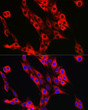


Anti-UFL1 antibody (601-794) (STJ11103362)
SPECIFICATIONS
ClonalityPolyclonal
HostRabbit
ConjugationUnconjugated
IsotypeIgG
General Information
| Short Description | Rabbit polyclonal UFL1 (601-794) antibody for use in WB, IF, ICC and ELISA in human, mouse and rat samples. Datasheet included with dilution recommendations, and related reagents. |
| Applications | WB/IF/ICC/ELISA |
| Host | Rabbit |
| Reactivity | Human/Mouse/Rat |
| Note | STRICTLY FOR FURTHER SCIENTIFIC RESEARCH USE ONLY (RUO). MUST NOT TO BE USED IN DIAGNOSTIC OR THERAPEUTIC APPLICATIONS. |
Product Properties
| Clonality | Polyclonal |
| Isotype | IgG |
| Conjugation | Unconjugated |
| Concentration | Lot specific |
| Purification | Affinity purification |
| Dilution Range | WB:1:500-1:1000IF/ICC:1:50-1:200ELISA:Recommended starting concentration is 1 Mu g/mL. Please optimize the concentration based on your specific assay requirements. |
| Formulation | PBS with 0.09% Sodium Azide, 50% Glycerol, pH7.3. |
| Storage Instruction | Store at-20°C for up to 1 year from the date of receipt, and avoid repeat freeze-thaw cycles. |
Target Information
| Gene Symbol | UFL1 |
| Gene ID | 23376 |
| Uniprot ID | UFL1_HUMAN |
| Immunogen Region | 601-794 |
| Immunogen Sequence | AAITSEIRKKILSKLSEETK VALTKLHNSLNEKSIEDFIS CLDSAAEACDIMVKRGDKKR ERQILFQHRQALAEQLKVTE DPALILHLTSVLLFQFSTHS MLHAPGRCVPQIIAFLNSKI PEDQHALLVKYQGLVVKQLV SQSKKTGQGDYPLNNELDKE QEDVASTTRKELQELSSSIK DLVLKSRKSSVTEE |
| Specificity | Recombinant fusion protein containing a sequence corresponding to amino acids 601-794 of human UFL1 (NP_056138.1). |
Additional Info
| Tissue Specificity | Ubiquitously expressed, with a high expression in liver (at protein level). Low expression in several invasive hepatocellular carcinomas, such Hep-G2, Hep 3B2.1-7, HLE and PLC. |
| Post Translational Modifications | Ubiquitinated, leading to its degradation by the proteasome. Interaction with CDK5RAP3 protects both proteins against ubiquitination and degradation via the proteasome. Phosphorylated at Ser-462 by ATM, enhancing protein ligase activity and promoting ATM activation in a positive feedback loop. Phosphorylation at Thr-536 by AMPK promotes its interaction with YWHAG/14-3-3-gamma, thereby preventing UFL1 association with PDCD1/PD-1 substrate. |
| Function | E3 protein ligase that mediates ufmylation, the covalent attachment of the ubiquitin-like modifier UFM1 to lysine residues on target proteins, and which plays a key role in various processes, such as ribosome recycling, response to DNA damage, interferon response or reticulophagy (also called ER-phagy). Catalyzes ufmylation of many protein, such as CD274/PD-L1, CDK5RAP3, CYB5R3, DDRGK1, EIF6, histone H4, MRE11, P4HB, PDCD1/PD-1, TRIP4, RPN1, RPS20/uS10, RPL10/uL16, RPL26/uL24, SYVN1/HRD1 and TP53/p53. As part of the UREL complex, plays a key role in ribosome recycling by catalyzing mono-ufmylation of RPL26/uL24 subunit of the 60S ribosome. Ufmylation of RPL26/uL24 occurs on free 60S ribosomes following ribosome dissociation: it weakens the junction between post-termination 60S subunits and SEC61 translocons, promoting release and recycling of the large ribosomal subunit from the endoplasmic reticulum membrane. Ufmylation of RPL26/uL24 and subsequent 60S ribosome recycling either take place after normal termination of translation or after ribosome stalling during cotranslational translocation at the endoplasmic reticulum. Involved in reticulophagy in response to endoplasmic reticulum stress by mediating ufmylation of proteins such as CYB5R3 and RPN1, thereby promoting lysosomal degradation of ufmylated proteins. Ufmylation in response to endoplasmic reticulum stress is essential for processes such as hematopoiesis, blood vessel morphogenesis or inflammatory response. Mediates ufmylation of DDRGK1 and CDK5RAP3.the role of these modifications is however unclear: as both DDRGK1 and CDK5RAP3 act as substrate adapters for ufmylation, it is uncertain whether ufmylation of these proteins is, a collateral effect or is required for ufmylation. Acts as a negative regulator of T-cell activation by mediating ufmylation and stabilization of PDCD1/PD-1. Also involved in the response to DNA damage: recruited to double-strand break sites following DNA damage and mediates monoufmylation of histone H4 and ufmylation of MRE11. Mediates ufmylation of TP53/p53, promoting its stability. Catalyzes ufmylation of TRIP4, thereby playing a role in nuclear receptor-mediated transcription. Required for hematopoietic stem cell function and hematopoiesis. |
| Protein Name | E3 Ufm1-Protein Ligase 1E3 Ufm1-Protein Transferase 1Multiple Alpha-Helix Protein Located At ErNovel Lzap-Binding ProteinRegulator Of C53/Lzap And Ddrgk1 |
| Database Links | Reactome: R-HSA-983168 |
| Cellular Localisation | Endoplasmic Reticulum MembraneCytoplasmCytosolNucleusChromosomeRecruited To Double-Strand Breaks By The Mre11-Rad50-Nbn (Mrn) Complex Following Dna Damage |
| Alternative Antibody Names | Anti-E3 Ufm1-Protein Ligase 1 antibodyAnti-E3 Ufm1-Protein Transferase 1 antibodyAnti-Multiple Alpha-Helix Protein Located At Er antibodyAnti-Novel Lzap-Binding Protein antibodyAnti-Regulator Of C53/Lzap And Ddrgk1 antibodyAnti-UFL1 antibodyAnti-KIAA0776 antibodyAnti-MAXER antibodyAnti-NLBP antibodyAnti-RCAD antibody |
Information sourced from Uniprot.org