

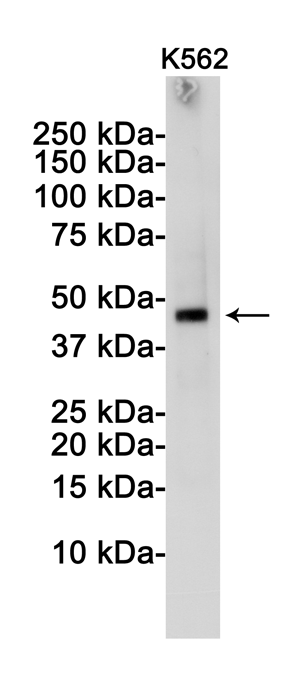

Anti-TSG101 antibody [R01-9A7] (STJA0034959)
SPECIFICATIONS
ClonalityMonoclonal
HostRabbit
ConjugationUnconjugated
IsotypeIgG
ImmunogenA synthetic peptide of human TSG101
General Information
| Short Description | Rabbit monoclonal anti-TSG101 for use in WB and IP in Human samples. Datasheet included with dilution recommendations, and related reagents. |
| Applications | WB/IP |
| Host | Rabbit |
| Reactivity | Human |
| Note | STRICTLY FOR FURTHER SCIENTIFIC RESEARCH USE ONLY (RUO). MUST NOT TO BE USED IN DIAGNOSTIC OR THERAPEUTIC APPLICATIONS. |
Product Properties
| Clonality | Monoclonal |
| Clone ID | R01-9A7 |
| Isotype | IgG |
| Conjugation | Unconjugated |
| Concentration | 0.3 mg/mL |
| Purification | Affinity Purified |
| Dilution Range | WB 1:500-1:1000IP 1:20 |
| Formulation | 50mM Tris-Glycine (pH 7.4) , 0.15M NaCl, 40% Glycerol, 0.01% Sodium azide and 0.05% BSA |
| Storage Instruction | Store at 4°C short term. Aliquot and store at-20°C long term. Avoid freeze/thaw cycles. |
Target Information
| Gene Symbol | TSG101 |
| Gene ID | 7251 |
| Uniprot ID | TS101_HUMAN |
| Immunogen | A synthetic peptide of human TSG101 |
Additional Info
| Tissue Specificity | Heart, brain, placenta, lung, liver, skeletal, kidney and pancreas. |
| Post Translational Modifications | Monoubiquitinated at multiple sites by LRSAM1 and by MGRN1. Ubiquitination inactivates it, possibly by regulating its shuttling between an active membrane-bound protein and an inactive soluble form. Ubiquitination by MGRN1 requires the presence of UBE2D1. |
| Function | Component of the ESCRT-I complex, a regulator of vesicular trafficking process. Binds to ubiquitinated cargo proteins and is required for the sorting of endocytic ubiquitinated cargos into multivesicular bodies (MVBs). Mediates the association between the ESCRT-0 and ESCRT-I complex. Required for completion of cytokinesis.the function requires CEP55. May be involved in cell growth and differentiation. Acts as a negative growth regulator. Involved in the budding of many viruses through an interaction with viral proteins that contain a late-budding motif P-ST-A-P. This interaction is essential for viral particle budding of numerous retroviruses. Required for the exosomal release of SDCBP, CD63 and syndecan. It may also play a role in the extracellular release of microvesicles that differ from the exosomes. |
| Protein Name | Tumor Susceptibility Gene 101 ProteinEscrt-I Complex Subunit Tsg101 |
| Database Links | Reactome: R-HSA-162588Reactome: R-HSA-174490Reactome: R-HSA-917729Reactome: R-HSA-9610379Reactome: R-HSA-9615710 |
| Cellular Localisation | CytoplasmEarly Endosome MembranePeripheral Membrane ProteinCytoplasmic SideLate Endosome MembraneCytoskeletonMicrotubule Organizing CenterCentrosomeMidbodyMidbody RingNucleusMainly CytoplasmicMembrane-Associated When Active And Soluble When InactiveNuclear Localization Is Cell Cycle-DependentInteraction With Cep55 Is Required For Localization To The Midbody During Cytokinesis |
| Alternative Antibody Names | Anti-Tumor Susceptibility Gene 101 Protein antibodyAnti-Escrt-I Complex Subunit Tsg101 antibodyAnti-TSG101 antibody |
Information sourced from Uniprot.org