



Anti-TRPM8 antibody (C-Term) (STJA0005746)
SPECIFICATIONS
ClonalityPolyclonal
HostRabbit
ConjugationUnconjugated
IsotypeIgG
ImmunogenSynthetic peptide corresponding to amino acids from the C-terminal region of human TRPMs protein
General Information
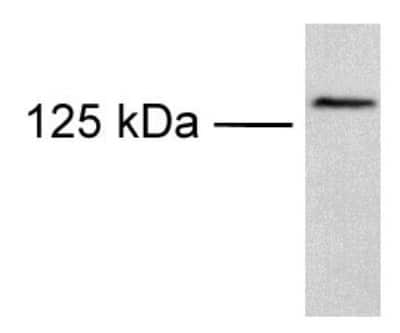
| Short Description | Rabbit polyclonal anti-TRPM8 (C-Term) for use in WB in Human samples. Datasheet included with dilution recommendations, and related reagents. |
| Applications | WB |
| Host | Rabbit |
| Reactivity | Human |
| Note | STRICTLY FOR FURTHER SCIENTIFIC RESEARCH USE ONLY (RUO). MUST NOT TO BE USED IN DIAGNOSTIC OR THERAPEUTIC APPLICATIONS. |
Product Properties
| Clonality | Polyclonal |
| Isotype | IgG |
| Conjugation | Unconjugated |
| Purification | Antigen Affinity Purified |
| Dilution Range | WB 1:500-1:1000 |
| Formulation | PBS + 0.02% NaN3 |
| Storage Instruction | Store at-20°C for up to 1 year from the date of receipt, and avoid repeat freeze-thaw cycles. |
Target Information
| Gene Symbol | TRPM8 |
| Gene ID | 79054 |
| Uniprot ID | TRPM8_HUMAN |
| Immunogen | Synthetic peptide corresponding to amino acids from the C-terminal region of human TRPMs protein |
| Immunogen Region | C-Term |
| Specificity | Reacts with the C-terminal region of human TRPMs protein |
Additional Info
| Function | Non-selective ion channel permeable to monovalent and divalent cations, including Na(+), K(+), and Ca(2+), with higher permeability for Ca(2+). Activated by multiple factors, such as temperature, voltage, pressure, and changes in osmolality. Activated by cool temperatures (<23-28 degrees Celsius) and by chemical ligands evoking a sensation of coolness, such as menthol and icilin therefore plays a central role in the detection of environmental cold temperatures. TRPM8 is a voltage-dependent channel.its activation by cold or chemical ligands shifts its voltage thresholds towards physiological membrane potentials, leading to the opening of the channel. In addition to its critical role in temperature sensing, regulates basal tear secretion by sensing evaporation-induced cooling and changes in osmolality. May plays a role in prostate cancer cell migration. Isoform 2: Negatively regulates menthol- and cold-induced channel activity by stabilizing the closed state of the channel. Isoform 3: Negatively regulates menthol- and cold-induced channel activity by stabilizing the closed state of the channel. |
| Protein Name | Transient Receptor Potential Cation Channel Subfamily M Member 8Long Transient Receptor Potential Channel 6Ltrpc-6Ltrpc6Transient Receptor Potential P8Trp-P8 |
| Database Links | Reactome: R-HSA-3295583 |
| Cellular Localisation | Cell MembraneMulti-Pass Membrane ProteinMembrane RaftEndoplasmic Reticulum MembraneLipid Raft Association Modulates Trpm8 Channel ActivityLocated In The Endoplasmic Reticulum In Prostate Cancer Cells |
| Alternative Antibody Names | Anti-Transient Receptor Potential Cation Channel Subfamily M Member 8 antibodyAnti-Long Transient Receptor Potential Channel 6 antibodyAnti-Ltrpc-6 antibodyAnti-Ltrpc6 antibodyAnti-Transient Receptor Potential P8 antibodyAnti-Trp-P8 antibodyAnti-TRPM8 antibodyAnti-LTRPC6 antibodyAnti-TRPP8 antibody |
Information sourced from Uniprot.org