

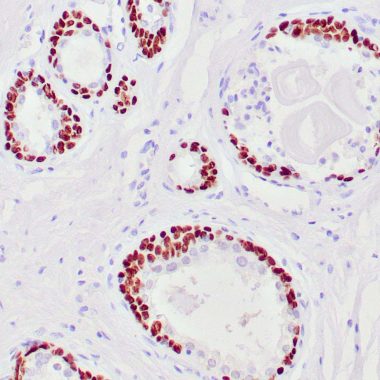

Anti-TP63 antibody (Full length) [4A4] (STJ180209)
SPECIFICATIONS
ClonalityMonoclonal
HostMouse
ConjugationUnconjugated
IsotypeIgG2ak
ImmunogenRecombinant full-length human p63 protein
General Information
| Short Description | Mouse monoclonal TP63 (Full length) antibody for use in IHC-P in human, mouse and rat samples. Datasheet included with dilution recommendations, and related reagents. |
| Applications | IHC-P |
| Host | Mouse |
| Reactivity | Human/Mouse/Rat |
| Note | STRICTLY FOR FURTHER SCIENTIFIC RESEARCH USE ONLY (RUO). MUST NOT TO BE USED IN DIAGNOSTIC OR THERAPEUTIC APPLICATIONS. |
Product Properties
| Clonality | Monoclonal |
| Clone ID | 4A4 |
| Isotype | IgG2ak |
| Conjugation | Unconjugated |
| Purification | Affinity purified |
| Dilution Range | 1:100-200 |
| Formulation | Tris-HCI buffer containing stabilizing protein (BSA) and <0.1% ProClin |
| Storage Instruction | Store at 2‐8°C for up to 24 months. Predilute: Ready to use, no reconstitution necessary. Concentrate: Use dilution range and appropriate lab‐standardized diluent. Stability after dilution: 7 days at 24°C, 3 months at 2‐8°C, 6months at ‐20°C. |
Target Information
| Gene Symbol | TP63 |
| Gene ID | 8626 |
| Uniprot ID | P63_HUMAN |
| Immunogen | Recombinant full-length human p63 protein |
| Immunogen Region | Full length |
| Specificity | Positive control: Skin or prostate |
Additional Info
| Tissue Specificity | Widely expressed, notably in heart, kidney, placenta, prostate, skeletal muscle, testis and thymus, although the precise isoform varies according to tissue type. Progenitor cell layers of skin, breast, eye and prostate express high levels of DeltaN-type isoforms. Isoform 10 is predominantly expressed in skin squamous cell carcinomas, but not in normal skin tissues. |
| Post Translational Modifications | May be sumoylated. Ubiquitinated. Polyubiquitination involves WWP1 and leads to proteasomal degradation of this protein. |
| Function | Acts as a sequence specific DNA binding transcriptional activator or repressor. The isoforms contain a varying set of transactivation and auto-regulating transactivation inhibiting domains thus showing an isoform specific activity. Isoform 2 activates RIPK4 transcription. May be required in conjunction with TP73/p73 for initiation of p53/TP53 dependent apoptosis in response to genotoxic insults and the presence of activated oncogenes. Involved in Notch signaling by probably inducing JAG1 and JAG2. Plays a role in the regulation of epithelial morphogenesis. The ratio of DeltaN-type and TA*-type isoforms may govern the maintenance of epithelial stem cell compartments and regulate the initiation of epithelial stratification from the undifferentiated embryonal ectoderm. Required for limb formation from the apical ectodermal ridge. Activates transcription of the p21 promoter. |
| Protein Name | Tumor Protein 63P63Chronic Ulcerative Stomatitis ProteinCuspKeratinocyte Transcription Factor KetTransformation-Related Protein 63Tp63Tumor Protein P73-LikeP73lP40P51 |
| Database Links | Reactome: R-HSA-139915Reactome: R-HSA-5620971Reactome: R-HSA-5628897Reactome: R-HSA-6803204Reactome: R-HSA-6803205Reactome: R-HSA-6803207Reactome: R-HSA-6803211Reactome: R-HSA-6804759Reactome: R-HSA-9725554 |
| Cellular Localisation | Nucleus |
| Alternative Antibody Names | Anti-Tumor Protein 63 antibodyAnti-P63 antibodyAnti-Chronic Ulcerative Stomatitis Protein antibodyAnti-Cusp antibodyAnti-Keratinocyte Transcription Factor Ket antibodyAnti-Transformation-Related Protein 63 antibodyAnti-Tp63 antibodyAnti-Tumor Protein P73-Like antibodyAnti-P73l antibodyAnti-P40 antibodyAnti-P51 antibodyAnti-TP63 antibodyAnti-KET antibodyAnti-P63 antibodyAnti-P73H antibodyAnti-P73L antibodyAnti-TP73L antibody |
Information sourced from Uniprot.org