

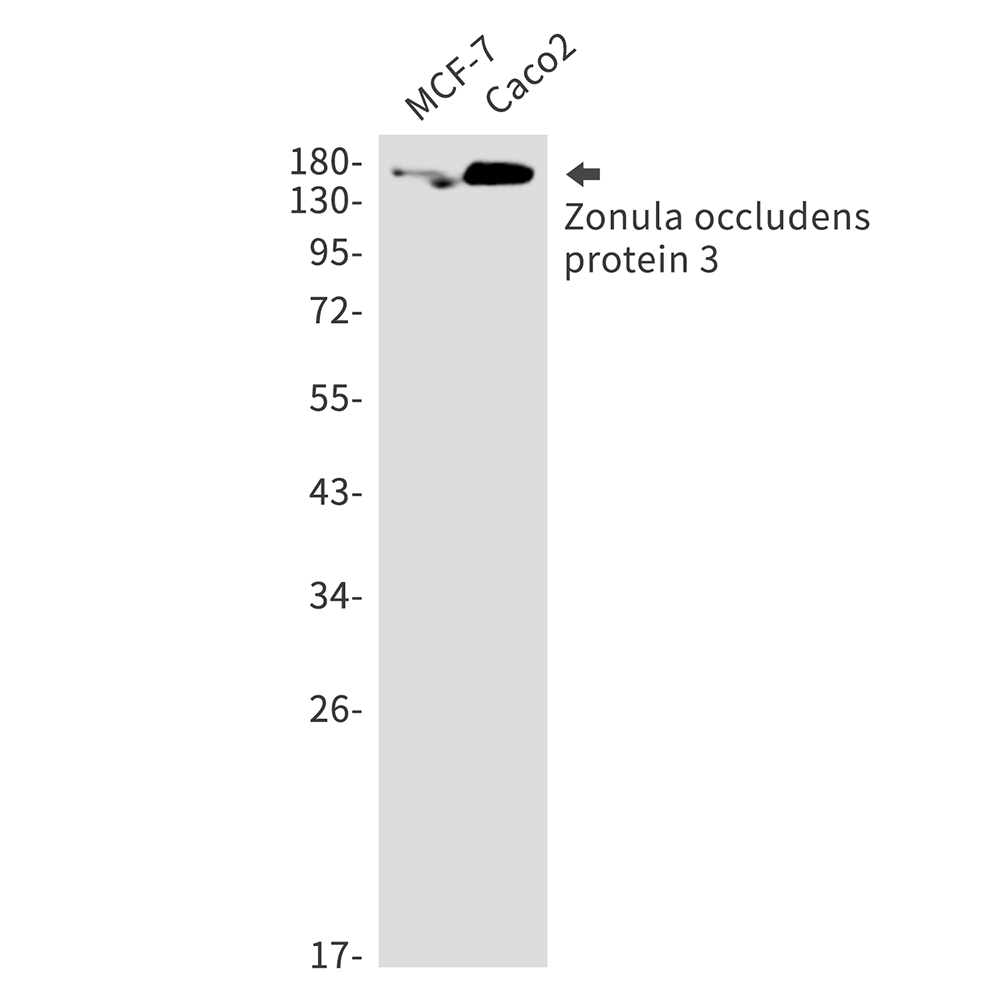

Anti-Tight Junction Protein ZO 3 antibody [R08-4E8] (STJA0035014)
SPECIFICATIONS
ClonalityMonoclonal
HostRabbit
ConjugationUnconjugated
IsotypeIgG
ImmunogenA synthetic peptide of human Zonula occludens protein 3
General Information
| Short Description | Rabbit monoclonal anti-Tight Junction Protein ZO 3 for use in WB in Human and Rat samples. Datasheet included with dilution recommendations, and related reagents. |
| Applications | WB |
| Host | Rabbit |
| Reactivity | Human/Rat |
| Note | STRICTLY FOR FURTHER SCIENTIFIC RESEARCH USE ONLY (RUO). MUST NOT TO BE USED IN DIAGNOSTIC OR THERAPEUTIC APPLICATIONS. |
Product Properties
| Clonality | Monoclonal |
| Clone ID | R08-4E8 |
| Isotype | IgG |
| Conjugation | Unconjugated |
| Concentration | 0.3 mg/mL |
| Purification | Affinity Purified |
| Dilution Range | WB 1:500-1:1000 |
| Formulation | 50mM Tris-Glycine (pH 7.4) , 0.15M NaCl, 40% Glycerol, 0.01% Sodium azide and 0.05% BSA |
| Storage Instruction | Store at 4°C short term. Aliquot and store at-20°C long term. Avoid freeze/thaw cycles. |
Target Information
| Gene Symbol | TJP3 |
| Gene ID | 27134 |
| Uniprot ID | ZO3_HUMAN |
| Immunogen | A synthetic peptide of human Zonula occludens protein 3 |
Additional Info
| Post Translational Modifications | Phosphorylated. |
| Function | TJP1, TJP2, and TJP3 are closely related scaffolding proteins that link tight junction (TJ) transmembrane proteins such as claudins, junctional adhesion molecules, and occludin to the actin cytoskeleton. The tight junction acts to limit movement of substances through the paracellular space and as a boundary between the compositionally distinct apical and basolateral plasma membrane domains of epithelial and endothelial cells. Binds and recruits PATJ to tight junctions where it connects and stabilizes apical and lateral components of tight junctions. Promotes cell-cycle progression through the sequestration of cyclin D1 (CCND1) at tight junctions during mitosis which prevents CCND1 degradation during M-phase and enables S-phase transition. With TJP1 and TJP2, participates in the junctional retention and stability of the transcription factor DBPA, but is not involved in its shuttling to the nucleus. Contrary to TJP2, TJP3 is dispensable for individual viability, embryonic development, epithelial differentiation, and the establishment of TJs, at least in the laboratory environment. |
| Protein Name | Tight Junction Protein Zo-3Tight Junction Protein 3Zona Occludens Protein 3Zonula Occludens Protein 3 |
| Database Links | |
| Cellular Localisation | Cell MembranePeripheral Membrane ProteinCytoplasmic SideCell JunctionTight JunctionNucleusExhibits Predominant Nuclear Expression In Proliferating Cells But Is Exclusively Junctionally Expressed After Confluence Is ReachedShows An Epithelial-Specific Tight Junction Localization In A Tjp1/Tjp2-Dependent Fashion |
| Alternative Antibody Names | Anti-Tight Junction Protein Zo-3 antibodyAnti-Tight Junction Protein 3 antibodyAnti-Zona Occludens Protein 3 antibodyAnti-Zonula Occludens Protein 3 antibodyAnti-TJP3 antibodyAnti-ZO3 antibody |
Information sourced from Uniprot.org