
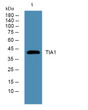


Anti-TIA1 antibody (201-250 aa) (STJ192549)
SPECIFICATIONS
ClonalityPolyclonal
HostRabbit
ConjugationUnconjugated
IsotypeIgG
ImmunogenSynthesized peptide derived from the human protein at the amino acid range 201-250
General Information
| Short Description | Rabbit polyclonal anti-Cytotoxic granule associated RNA binding protein TIA1 (201-250 aa) for use in WB and ELISA in Human and Mouse samples. Datasheet included with dilution recommendations, and related reagents. |
| Applications | WB/ELISA |
| Host | Rabbit |
| Reactivity | Human/Mouse |
| Note | STRICTLY FOR FURTHER SCIENTIFIC RESEARCH USE ONLY (RUO). MUST NOT TO BE USED IN DIAGNOSTIC OR THERAPEUTIC APPLICATIONS. |
Product Properties
| Clonality | Polyclonal |
| Isotype | IgG |
| Conjugation | Unconjugated |
| Concentration | 1 mg/mL |
| Purification | The antibody was affinity-purified from rabbit antiserum by affinity-chromatography using epitope-specific immunogen. |
| Dilution Range | WB 1:500-2000ELISA 1:5000-20000 |
| Formulation | Liquid in PBS containing 50% Glycerol and 0.02% Sodium Azide. |
| Storage Instruction | Store at-20°C for up to 1 year from the date of receipt, and avoid repeat freeze-thaw cycles. |
Target Information
| Gene Symbol | TIA1 |
| Gene ID | 7072 |
| Uniprot ID | TIA1_HUMAN |
| Immunogen | Synthesized peptide derived from the human protein at the amino acid range 201-250 |
| Immunogen Region | 201-250 aa |
| Specificity | TIA1 Polyclonal Antibody detects endogenous levels of protein. |
Additional Info
| Post Translational Modifications | Phosphorylated by FASTK.phosphorylation occurs after FAS ligation in FAS-mediated apoptosis and before DNA fragmentation. |
| Function | RNA-binding protein involved in the regulation of alternative pre-RNA splicing and mRNA translation by binding to uridine-rich (U-rich) RNA sequences. Binds to U-rich sequences immediately downstream from a 5' splice sites in a uridine-rich small nuclear ribonucleoprotein (U snRNP)-dependent fashion, thereby modulating alternative pre-RNA splicing. Preferably binds to the U-rich IAS1 sequence in a U1 snRNP-dependent manner.this binding is optimal if a 5' splice site is adjacent to IAS1. Activates the use of heterologous 5' splice sites.the activation depends on the intron sequence downstream from the 5' splice site, with a preference for a downstream U-rich sequence. By interacting with SNRPC/U1-C, promotes recruitment and binding of spliceosomal U1 snRNP to 5' splice sites followed by U-rich sequences, thereby facilitating atypical 5' splice site recognition by U1 snRNP. Activates splicing of alternative exons with weak 5' splice sites followed by a U-rich stretch on its own pre-mRNA and on TIAR mRNA. Acts as a modulator of alternative splicing for the apoptotic FAS receptor, thereby promoting apoptosis. Binds to the 5' splice site region of FAS intron 5 to promote accumulation of transcripts that include exon 6 at the expense of transcripts in which exon 6 is skipped, thereby leading to the transcription of a membrane-bound apoptotic FAS receptor, which promotes apoptosis. Binds to a conserved AU-rich cis element in COL2A1 intron 2 and modulates alternative splicing of COL2A1 exon 2. Also binds to the equivalent AT-rich element in COL2A1 genomic DNA, and may thereby be involved in the regulation of transcription. Binds specifically to a polypyrimidine-rich controlling element (PCE) located between the weak 5' splice site and the intronic splicing silencer of CFTR mRNA to promote exon 9 inclusion, thereby antagonizing PTB1 and its role in exon skipping of CFTR exon 9. Involved in the repression of mRNA translation by binding to AU-rich elements (AREs) located in mRNA 3' untranslated regions (3' UTRs), including target ARE-bearing mRNAs encoding TNF and PTGS2. Also participates in the cellular response to environmental stress, by acting downstream of the stress-induced phosphorylation of EIF2S1/EIF2A to promote the recruitment of untranslated mRNAs to cytoplasmic stress granules (SGs), leading to stress-induced translational arrest. Formation and recruitment to SGs is regulated by Zn(2+). Possesses nucleolytic activity against cytotoxic lymphocyte target cells. Isoform Short: Displays enhanced splicing regulatory activity compared with TIA isoform Long. |
| Protein Name | Cytotoxic Granule Associated Rna Binding Protein Tia1Nucleolysin Tia-1 Isoform P40Rna-Binding Protein Tia-1T-Cell-Restricted Intracellular Antigen-1Tia-1P40-Tia-1 |
| Database Links | Reactome: R-HSA-6803529 |
| Cellular Localisation | NucleusCytoplasmStress GranuleAccumulates In Cytoplasmic Stress Granules (Sg) Following Cellular DamageRecruitment To Sg Is Induced By Zn(2+) |
| Alternative Antibody Names | Anti-Cytotoxic Granule Associated Rna Binding Protein Tia1 antibodyAnti-Nucleolysin Tia-1 Isoform P40 antibodyAnti-Rna-Binding Protein Tia-1 antibodyAnti-T-Cell-Restricted Intracellular Antigen-1 antibodyAnti-Tia-1 antibodyAnti-P40-Tia-1 antibodyAnti-TIA1 antibody |
Information sourced from Uniprot.org