
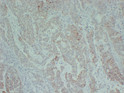


Anti-TGF beta Receptor II antibody [2C10-2G4-6C8] (STJA0033543)
SPECIFICATIONS
ClonalityMonoclonal
HostMouse
ConjugationUnconjugated
IsotypeIgG1
ImmunogenSynthesized peptide derived from human TGF Beta Receptor II
General Information
| Short Description | Mouse monoclonal anti-TGF beta Receptor II for use in IHC-P in Human samples. Datasheet included with dilution recommendations, and related reagents. |
| Applications | IHC-P |
| Host | Mouse |
| Reactivity | Human |
| Note | STRICTLY FOR FURTHER SCIENTIFIC RESEARCH USE ONLY (RUO). MUST NOT TO BE USED IN DIAGNOSTIC OR THERAPEUTIC APPLICATIONS. |
Product Properties
| Clonality | Monoclonal |
| Clone ID | 2C10-2G4-6C8 |
| Isotype | IgG1 |
| Conjugation | Unconjugated |
| Concentration | 1 mg/mL |
| Purification | Affinity Chromatography |
| Dilution Range | IHC 1:100-1:500 |
| Formulation | Liquid in PBS containing 50% glycerol, 0.5% BSA and 0.02% sodium azide, pH 7.3. |
| Storage Instruction | Store at 4°C short term. Aliquot and store at-20°C long term. Avoid freeze/thaw cycles. |
Target Information
| Gene Symbol | TGFBR2 |
| Gene ID | 7048 |
| Uniprot ID | TGFR2_HUMAN |
| Immunogen | Synthesized peptide derived from human TGF Beta Receptor II |
Additional Info
| Post Translational Modifications | Phosphorylated on a Ser/Thr residue in the cytoplasmic domain. |
| Function | Transmembrane serine/threonine kinase forming with the TGF-beta type I serine/threonine kinase receptor, TGFBR1, the non-promiscuous receptor for the TGF-beta cytokines TGFB1, TGFB2 and TGFB3. Transduces the TGFB1, TGFB2 and TGFB3 signal from the cell surface to the cytoplasm and thus regulates a plethora of physiological and pathological processes including cell cycle arrest in epithelial and hematopoietic cells, control of mesenchymal cell proliferation and differentiation, wound healing, extracellular matrix production, immunosuppression and carcinogenesis. The formation of the receptor complex composed of 2 TGFBR1 and 2 TGFBR2 molecules symmetrically bound to the cytokine dimer results in the phosphorylation and activation of TGFBR1 by the constitutively active TGFBR2. Activated TGFBR1 phosphorylates SMAD2 which dissociates from the receptor and interacts with SMAD4. The SMAD2-SMAD4 complex is subsequently translocated to the nucleus where it modulates the transcription of the TGF-beta-regulated genes. This constitutes the canonical SMAD-dependent TGF-beta signaling cascade. Also involved in non-canonical, SMAD-independent TGF-beta signaling pathways. Isoform 1: Has transforming growth factor beta-activated receptor activity. Isoform 2: Has transforming growth factor beta-activated receptor activity. Isoform 3: Binds TGFB1, TGFB2 and TGFB3 in the picomolar affinity range without the participation of additional receptors. Blocks activation of SMAD2 and SMAD3 by TGFB1. |
| Protein Name | Tgf-Beta Receptor Type-2Tgfr-2Tgf-Beta Type Ii ReceptorTransforming Growth Factor-Beta Receptor Type IiTgf-Beta Receptor Type IiTbetar-Ii |
| Database Links | Reactome: R-HSA-2173788Reactome: R-HSA-2173789Reactome: R-HSA-2173791Reactome: R-HSA-3304356Reactome: R-HSA-3642279Reactome: R-HSA-3645790Reactome: R-HSA-3656532Reactome: R-HSA-3656535Reactome: R-HSA-5689603Reactome: R-HSA-9839389 |
| Cellular Localisation | Cell MembraneSingle-Pass Type I Membrane ProteinMembrane RaftIsoform 3: Secreted |
| Alternative Antibody Names | Anti-Tgf-Beta Receptor Type-2 antibodyAnti-Tgfr-2 antibodyAnti-Tgf-Beta Type Ii Receptor antibodyAnti-Transforming Growth Factor-Beta Receptor Type Ii antibodyAnti-Tgf-Beta Receptor Type Ii antibodyAnti-Tbetar-Ii antibodyAnti-TGFBR2 antibody |
Information sourced from Uniprot.org