

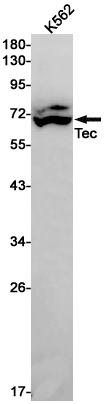
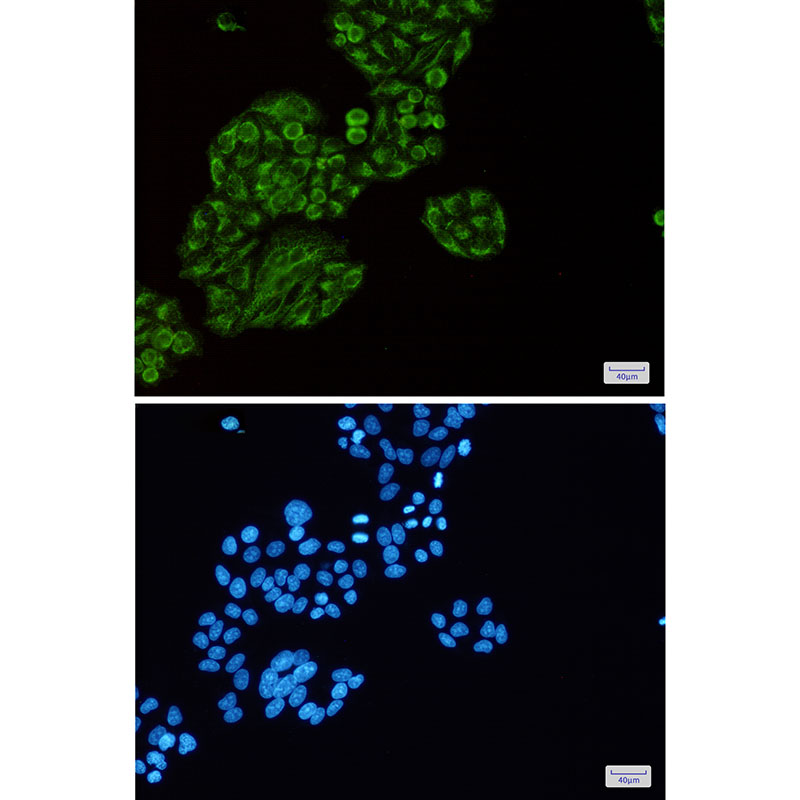

Anti-Tec antibody [R09-6E7] (STJA0034924)
SPECIFICATIONS
ClonalityMonoclonal
HostRabbit
ConjugationUnconjugated
IsotypeIgG
ImmunogenA synthetic peptide of human Tec
General Information
| Short Description | Rabbit monoclonal anti-Tec for use in WB, ICC and IF in Human samples. Datasheet included with dilution recommendations, and related reagents. |
| Applications | WB/ICC/IF |
| Host | Rabbit |
| Reactivity | Human |
| Note | STRICTLY FOR FURTHER SCIENTIFIC RESEARCH USE ONLY (RUO). MUST NOT TO BE USED IN DIAGNOSTIC OR THERAPEUTIC APPLICATIONS. |
Product Properties
| Clonality | Monoclonal |
| Clone ID | R09-6E7 |
| Isotype | IgG |
| Conjugation | Unconjugated |
| Concentration | 0.3 mg/mL |
| Purification | Affinity Purified |
| Dilution Range | WB 1:500-1:1000IF 1:50-1:200 |
| Formulation | 50mM Tris-Glycine (pH 7.4) , 0.15M NaCl, 40% Glycerol, 0.01% Sodium azide and 0.05% BSA |
| Storage Instruction | Store at 4°C short term. Aliquot and store at-20°C long term. Avoid freeze/thaw cycles. |
Target Information
| Gene Symbol | TEC |
| Gene ID | 7006 |
| Uniprot ID | TEC_HUMAN |
| Immunogen | A synthetic peptide of human Tec |
Additional Info
| Tissue Specificity | Expressed in a wide range of cells, including hematopoietic cell lines like myeloid, B-, and T-cell lineages. |
| Post Translational Modifications | Following B-cell or T-cell receptors engagement, translocates to the plasma membrane where it gets phosphorylated at Tyr-519. Undergoes also tyrosine phosphorylation during platelet activation. |
| Function | Non-receptor tyrosine kinase that contributes to signaling from many receptors and participates as a signal transducer in multiple downstream pathways, including regulation of the actin cytoskeleton. Plays a redundant role to ITK in regulation of the adaptive immune response. Regulates the development, function and differentiation of conventional T-cells and nonconventional NKT-cells. Required for TCR-dependent IL2 gene induction. Phosphorylates DOK1, one CD28-specific substrate, and contributes to CD28-signaling. Mediates signals that negatively regulate IL2RA expression induced by TCR cross-linking. Plays a redundant role to BTK in BCR-signaling for B-cell development and activation, especially by phosphorylating STAP1, a BCR-signaling protein. Required in mast cells for efficient cytokine production. Involved in both growth and differentiation mechanisms of myeloid cells through activation by the granulocyte colony-stimulating factor CSF3, a critical cytokine to promoting the growth, differentiation, and functional activation of myeloid cells. Participates in platelet signaling downstream of integrin activation. Cooperates with JAK2 through reciprocal phosphorylation to mediate cytokine-driven activation of FOS transcription. GRB10, a negative modifier of the FOS activation pathway, is another substrate of TEC. TEC is involved in G protein-coupled receptor- and integrin-mediated signalings in blood platelets. Plays a role in hepatocyte proliferation and liver regeneration and is involved in HGF-induced ERK signaling pathway. TEC also regulates FGF2 unconventional secretion (endoplasmic reticulum (ER)/Golgi-independent mechanism) under various physiological conditions through phosphorylation of FGF2 'Tyr-215'. May also be involved in the regulation of osteoclast differentiation. |
| Protein Name | Tyrosine-Protein Kinase Tec |
| Database Links | Reactome: R-HSA-1433557Reactome: R-HSA-2871809Reactome: R-HSA-512988 |
| Cellular Localisation | CytoplasmCell MembranePeripheral Membrane ProteinCytoskeletonFollowing B-Cell Or T-Cell Receptors Activation By AntigenTranslocates To The Plasma Membrane Through Its Ph DomainThrombin And Integrin Engagement Induces Translocation Of Tec To The Cytoskeleton During Platelet ActivationIn Cardiac MyocytesAssumes A Diffuse Intracellular Localization Under Basal Conditions But Is Recruited To Striated Structures Upon Various StimuliIncluding Atp |
| Alternative Antibody Names | Anti-Tyrosine-Protein Kinase Tec antibodyAnti-TEC antibodyAnti-PSCTK4 antibody |
Information sourced from Uniprot.org