

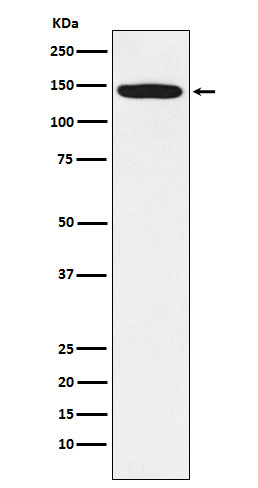

Anti-Tat SF1 antibody [R09-4L3] (STJA0037393)
SPECIFICATIONS
ClonalityMonoclonal
HostRabbit
ConjugationUnconjugated
IsotypeIgG
ImmunogenA synthesized peptide derived from human HTSF1
General Information
| Short Description | Rabbit monoclonal anti-Tat SF1 for use in WB, IHC-P, ICC, IF and IP in Human and Mouse samples. Datasheet included with dilution recommendations, and related reagents. |
| Applications | WB/IHC-P/ICC/IF/IP |
| Host | Rabbit |
| Reactivity | Human/Mouse |
| Note | STRICTLY FOR FURTHER SCIENTIFIC RESEARCH USE ONLY (RUO). MUST NOT TO BE USED IN DIAGNOSTIC OR THERAPEUTIC APPLICATIONS. |
Product Properties
| Clonality | Monoclonal |
| Clone ID | R09-4L3 |
| Isotype | IgG |
| Conjugation | Unconjugated |
| Purification | Affinity Purified |
| Dilution Range | WB 1:500-1:1000IHC 1:50-1:100IF 1:50-1:200IP 1:50 |
| Formulation | Rabbit IgG in phosphate buffered saline, pH 7.4, 150mM NaCl, 0.02% sodium azide and 50% glycerol. |
| Storage Instruction | Store at 4°C short term. Aliquot and store at-20°C long term. Avoid freeze/thaw cycles. |
Target Information
| Gene Symbol | HTATSF1 |
| Gene ID | 27336 |
| Uniprot ID | HTSF1_HUMAN |
| Immunogen | A synthesized peptide derived from human HTSF1 |
Additional Info
| Tissue Specificity | Widely expressed. |
| Post Translational Modifications | Phosphorylation at Ser-748 by CK2 during S-phase in response to DNA damage promotes interaction with TOPBP1 and double-strand break (DSB) repair via homologous recombination. |
| Function | Component of the 17S U2 SnRNP complex of the spliceosome, a large ribonucleoprotein complex that removes introns from transcribed pre-mRNAs. The 17S U2 SnRNP complex (1) directly participates in early spliceosome assembly and (2) mediates recognition of the intron branch site during pre-mRNA splicing by promoting the selection of the pre-mRNA branch-site adenosine, the nucleophile for the first step of splicing. Within the 17S U2 SnRNP complex, HTATSF1 is required to stabilize the branchpoint-interacting stem loop. HTATSF1 is displaced from the 17S U2 SnRNP complex before the stable addition of the 17S U2 SnRNP complex to the spliceosome, destabilizing the branchpoint-interacting stem loop and allowing to probe intron branch site sequences. Also acts as a regulator of transcriptional elongation, possibly by mediating the reciprocal stimulatory effect of splicing on transcriptional elongation. Involved in double-strand break (DSB) repair via homologous recombination in S-phase by promoting the recruitment of TOPBP1 to DNA damage sites. Mechanistically, HTATSF1 is (1) recruited to DNA damage sites in S-phase via interaction with poly-ADP-ribosylated RPA1 and (2) phosphorylated by CK2, promoting recruitment of TOPBP1, thereby facilitating RAD51 nucleofilaments formation and RPA displacement, followed by homologous recombination. (Microbial infection) In case of infection by HIV-1, it is up-regulated by the HIV-1 proteins NEF and gp120, acts as a cofactor required for the Tat-enhanced transcription of the virus. |
| Protein Name | 17s U2 Snrnp Complex Component Htatsf1Hiv Tat-Specific Factor 1Tat-Sf1 |
| Database Links | Reactome: R-HSA-72163 |
| Cellular Localisation | NucleusChromosomeRecruited To Dna Damage Sites During S-Phase Following Interaction With Poly-Adp-Ribosylated Rpa1 |
| Alternative Antibody Names | Anti-17s U2 Snrnp Complex Component Htatsf1 antibodyAnti-Hiv Tat-Specific Factor 1 antibodyAnti-Tat-Sf1 antibodyAnti-HTATSF1 antibody |
Information sourced from Uniprot.org