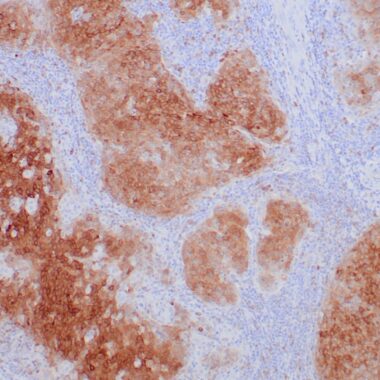
| Tissue Specificity | Ubiquitous. Expression is strongest in fetal and adult brain, spinal cord, and cerebellum, followed by thymus, bone marrow, testis, and fetal liver. Expression is intermediate in colon, ovary, placenta, uterus, and trachea, and is readily detected at substantially lower levels in all other tissues examined. Lowest expression is found in adult liver. Present in much greater abundance in cells from patients with acute leukemia of different subtypes than in normal peripheral blood lymphocytes, non-leukemic proliferating lymphoid cells, bone marrow cells, or cells from patients with chronic lymphoid or myeloid leukemia. |
| Post Translational Modifications | Many different phosphorylated forms are observed depending on specific combinations among the sites which can be phosphorylated. MAPK is responsible for the phosphorylation of stathmin in response to NGF. Phosphorylation at Ser-16 seems to be required for neuron polarization. Phosphorylation at Ser-63 reduces tubulin binding 10-fold and suppresses the MT polymerization inhibition activity. |
| Function | Involved in the regulation of the microtubule (MT) filament system by destabilizing microtubules. Prevents assembly and promotes disassembly of microtubules. Phosphorylation at Ser-16 may be required for axon formation during neurogenesis. Involved in the control of the learned and innate fear. |
| Protein Name | StathminLeukemia-Associated Phosphoprotein P18MetablastinOncoprotein 18Op18Phosphoprotein P19Pp19ProsolinProtein Pr22Pp17 |
| Database Links | Reactome: R-HSA-1251985 |
| Cellular Localisation | CytoplasmCytoskeleton |
| Alternative Antibody Names | Anti-Stathmin antibodyAnti-Leukemia-Associated Phosphoprotein P18 antibodyAnti-Metablastin antibodyAnti-Oncoprotein 18 antibodyAnti-Op18 antibodyAnti-Phosphoprotein P19 antibodyAnti-Pp19 antibodyAnti-Prosolin antibodyAnti-Protein Pr22 antibodyAnti-Pp17 antibodyAnti-STMN1 antibodyAnti-C1orf215 antibodyAnti-LAP18 antibodyAnti-OP18 antibody |
Information sourced from Uniprot.org