


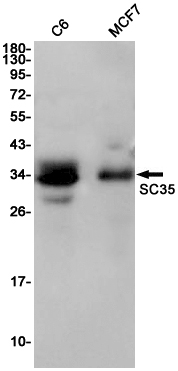
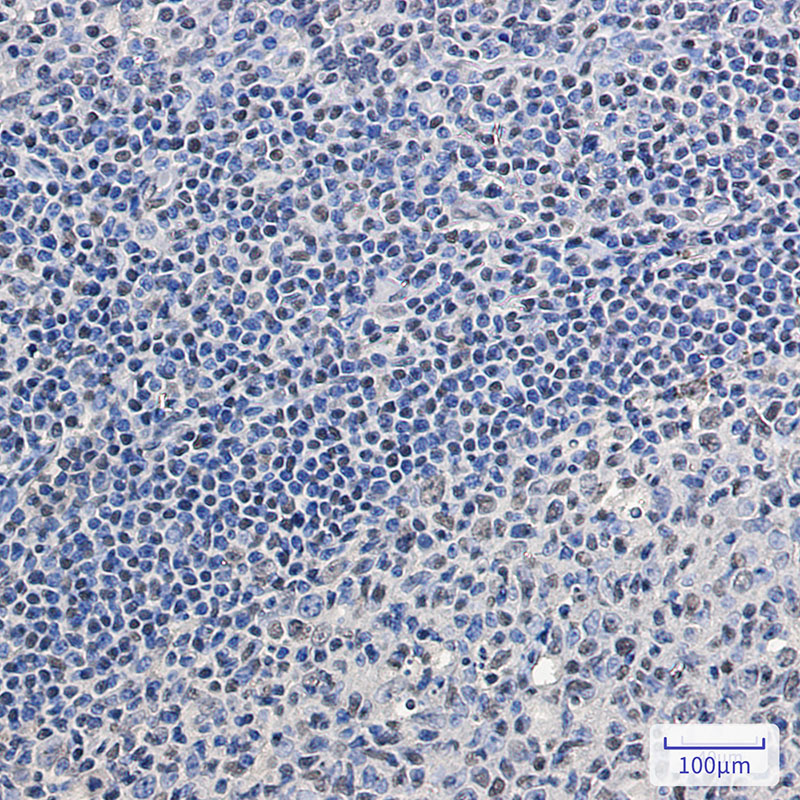

Anti-SRSF2 antibody (60-73 aa) [R04-7J2] (STJA0011934)
SPECIFICATIONS
ClonalityMonoclonal
HostRabbit
ConjugationUnconjugated
IsotypeIgG
ImmunogenA synthetic peptide of human SC35
General Information
| Short Description | Rabbit monoclonal anti-SC35 (60-73 aa) for use in WB, IHC-P and IP in Human and Rat samples. Datasheet included with dilution recommendations, and related reagents. |
| Applications | WB/IHC-P/IP |
| Host | Rabbit |
| Reactivity | Human/Rat |
| Note | STRICTLY FOR FURTHER SCIENTIFIC RESEARCH USE ONLY (RUO). MUST NOT TO BE USED IN DIAGNOSTIC OR THERAPEUTIC APPLICATIONS. |
Product Properties
| Clonality | Monoclonal |
| Clone ID | R04-7J2 |
| Isotype | IgG |
| Conjugation | Unconjugated |
| Concentration | 0.3 mg/mL |
| Purification | Affinity Purified |
| Dilution Range | WB 1:500-1:1000IHC 1:50-1:100IP 1:20 |
| Formulation | 50mM Tris-Glycine (pH7.4) , 0.15M NaCl, 40% Glycerol, 0.01% Sodium azide and 0.05% BSA |
| Storage Instruction | Store at 4°C short term. Aliquot and store at-20°C long term. Avoid freeze/thaw cycles. |
Target Information
| Gene Symbol | SRSF2 |
| Gene ID | 6427 |
| Uniprot ID | SRSF2_HUMAN |
| Immunogen | A synthetic peptide of human SC35 |
| Immunogen Region | 60-73 aa |
Additional Info
| Post Translational Modifications | Extensively phosphorylated on serine residues in the RS domain. Phosphorylated by SRPK2 and this causes its redistribution from the nuclear speckle to nucleoplasm and controls cell fate decision in response to cisplatin treatment. KAT5/TIP60 inhibits its phosphorylation by preventing SRPK2 nuclear translocation. Acetylation on Lys-52 by KAT5/TIP60 promotes its proteasomal degradation. This effect is counterbalanced by HDAC6, which positively controls SRSF2 protein level by deacetylating it and preventing its proteasomal degradation. |
| Function | Necessary for the splicing of pre-mRNA. It is required for formation of the earliest ATP-dependent splicing complex and interacts with spliceosomal components bound to both the 5'- and 3'-splice sites during spliceosome assembly. It also is required for ATP-dependent interactions of both U1 and U2 snRNPs with pre-mRNA. Interacts with other spliceosomal components, via the RS domains, to form a bridge between the 5'- and 3'-splice site binding components, U1 snRNP and U2AF. Binds to purine-rich RNA sequences, either 5'-AGSAGAGTA-3' (S=C or G) or 5'-GTTCGAGTA-3'. Can bind to beta-globin mRNA and commit it to the splicing pathway. The phosphorylated form (by SRPK2) is required for cellular apoptosis in response to cisplatin treatment. |
| Protein Name | Serine/Arginine-Rich Splicing Factor 2Protein Pr264Splicing Component - 35 KdaSplicing Factor Sc35Sc-35Splicing Factor - Arginine/Serine-Rich 2 |
| Database Links | Reactome: R-HSA-159236Reactome: R-HSA-72163Reactome: R-HSA-72165Reactome: R-HSA-72187Reactome: R-HSA-72203Reactome: R-HSA-73856 |
| Cellular Localisation | NucleusNucleoplasmNucleus SpecklePhosphorylation By Srpk2 Provokes Its Redistribution From The Nuclear Speckle To Nucleoplasm |
| Alternative Antibody Names | Anti-Serine/Arginine-Rich Splicing Factor 2 antibodyAnti-Protein Pr264 antibodyAnti-Splicing Component - 35 Kda antibodyAnti-Splicing Factor Sc35 antibodyAnti-Sc-35 antibodyAnti-Splicing Factor - Arginine/Serine-Rich 2 antibodyAnti-SRSF2 antibodyAnti-SFRS2 antibody |
Information sourced from Uniprot.org