

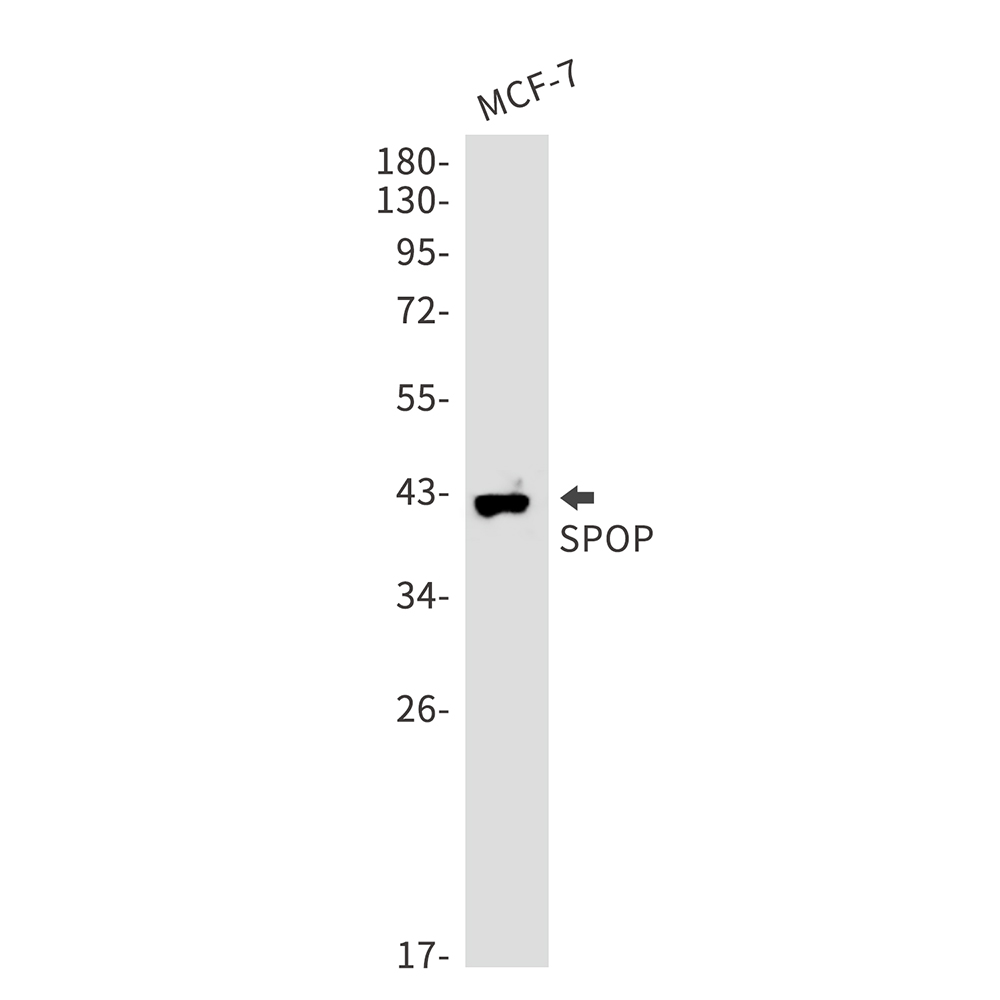

Anti-SPOP antibody [R01-5B7] (STJA0034884)
SPECIFICATIONS
ClonalityMonoclonal
HostRabbit
ConjugationUnconjugated
IsotypeIgG
ImmunogenA synthetic peptide of human SPOP
General Information
| Short Description | Rabbit monoclonal anti-SPOP for use in WB in Human samples. Datasheet included with dilution recommendations, and related reagents. |
| Applications | WB |
| Host | Rabbit |
| Reactivity | Human |
| Note | STRICTLY FOR FURTHER SCIENTIFIC RESEARCH USE ONLY (RUO). MUST NOT TO BE USED IN DIAGNOSTIC OR THERAPEUTIC APPLICATIONS. |
Product Properties
| Clonality | Monoclonal |
| Clone ID | R01-5B7 |
| Isotype | IgG |
| Conjugation | Unconjugated |
| Concentration | 0.3 mg/mL |
| Purification | Affinity Purified |
| Dilution Range | WB 1:500-1:1000 |
| Formulation | 50mM Tris-Glycine (pH 7.4) , 0.15M NaCl, 40% Glycerol, 0.01% Sodium azide and 0.05% BSA |
| Storage Instruction | Store at 4°C short term. Aliquot and store at-20°C long term. Avoid freeze/thaw cycles. |
Target Information
| Gene Symbol | SPOP |
| Gene ID | 8405 |
| Uniprot ID | SPOP_HUMAN |
| Immunogen | A synthetic peptide of human SPOP |
Additional Info
| Tissue Specificity | Widely expressed. |
| Function | Component of a cullin-RING-based BCR (BTB-CUL3-RBX1) E3 ubiquitin-protein ligase complex that mediates the ubiquitination of target proteins, leading most often to their proteasomal degradation. In complex with CUL3, involved in ubiquitination and proteasomal degradation of BRMS1, DAXX, PDX1/IPF1, GLI2 and GLI3. In complex with CUL3, involved in ubiquitination of MACROH2A1 and BMI1.this does not lead to their proteasomal degradation. Inhibits transcriptional activation of PDX1/IPF1 targets, such as insulin, by promoting PDX1/IPF1 degradation. The cullin-RING-based BCR (BTB-CUL3-RBX1) E3 ubiquitin-protein ligase complex containing homodimeric SPOP has higher ubiquitin ligase activity than the complex that contains the heterodimer formed by SPOP and SPOPL. Involved in the regulation of bromodomain and extra-terminal motif (BET) proteins BRD2, BRD3, BRD4 stability. Plays an essential role for proper translation, but not for their degradation, of critical DNA replication licensing factors CDT1 and CDC6, thereby participating in DNA synthesis and cell proliferation. Regulates interferon regulatory factor 1/IRF1 proteasomal turnover by targeting S/T-rich degrons in IRF1. Facilitates the lysosome-dependent degradation of enterovirus EV71 protease 2A by inducing its 'Lys-48'-linked polyubiquitination, which ultimately restricts EV71 replication. Acts as an antiviral factor also against hepatitis B virus/HBV by promoting ubiquitination and subsequent degradation of HNF1A. In turn, inhibits HBV transcription and replication by preventing HNF1A stimulating activity of HBV preS1 promoter and enhancer II. Involved in ubiquitination of BRDT and promotes its degradation, thereby regulates histone removal in early condensing spermatids prior to histone-to-protamine exchange. |
| Protein Name | Speckle-Type Poz ProteinHib Homolog 1Roadkill Homolog 1 |
| Database Links | Reactome: R-HSA-5632684 |
| Cellular Localisation | NucleusNucleus SpeckleCytoplasm |
| Alternative Antibody Names | Anti-Speckle-Type Poz Protein antibodyAnti-Hib Homolog 1 antibodyAnti-Roadkill Homolog 1 antibodyAnti-SPOP antibody |
Information sourced from Uniprot.org