


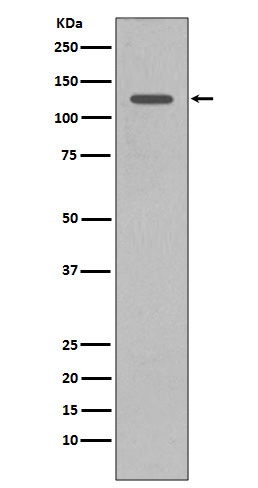
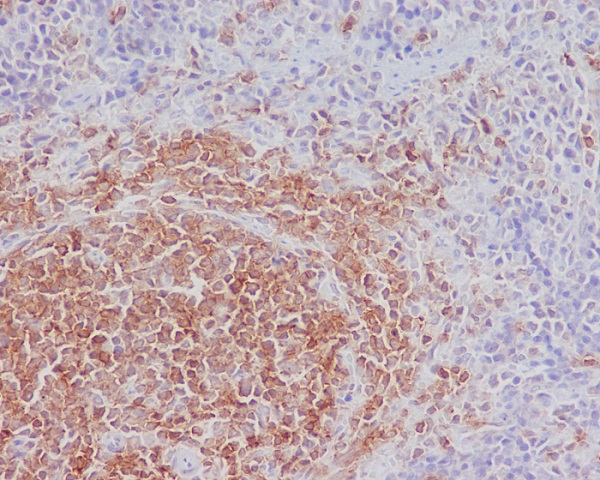

Anti-SHIP1 antibody [R01-5G4] (STJA0035804)
SPECIFICATIONS
ClonalityMonoclonal
HostRabbit
ConjugationUnconjugated
IsotypeIgG
ImmunogenA synthesized peptide derived from human SHIP
General Information
| Short Description | Rabbit monoclonal anti-SHIP1 for use in WB, IHC-P, IP and FC in Human samples. Datasheet included with dilution recommendations, and related reagents. |
| Applications | WB/IHC-P/IP/FC |
| Host | Rabbit |
| Reactivity | Human |
| Note | STRICTLY FOR FURTHER SCIENTIFIC RESEARCH USE ONLY (RUO). MUST NOT TO BE USED IN DIAGNOSTIC OR THERAPEUTIC APPLICATIONS. |
Product Properties
| Clonality | Monoclonal |
| Clone ID | R01-5G4 |
| Isotype | IgG |
| Conjugation | Unconjugated |
| Purification | Affinity Chromatography |
| Dilution Range | WB 1:500-1:1000IHC 1:50-1:100IP 1:50FC 1:50-1:100 |
| Formulation | Rabbit IgG in phosphate buffered saline, pH 7.4, 150mM NaCl, 0.02% sodium azide and 50% glycerol. |
| Storage Instruction | Store at 4°C short term. Aliquot and store at-20°C long term. Avoid freeze/thaw cycles. |
Target Information
| Gene Symbol | INPP5D |
| Gene ID | 3635 |
| Uniprot ID | SHIP1_HUMAN |
| Immunogen | A synthesized peptide derived from human SHIP |
Additional Info
| Tissue Specificity | Specifically expressed in immune and hematopoietic cells. Expressed in bone marrow and blood cells. Levels vary considerably within this compartment. Present in at least 74% of immature CD34+ cells, whereas within the more mature population of CD33+ cells, it is present in only 10% of cells. Present in the majority of T-cells, while it is present in a minority of B-cells (at protein level). |
| Post Translational Modifications | Tyrosine phosphorylated by the members of the SRC family after exposure to a diverse array of extracellular stimuli such as cytokines, growth factors, antibodies, chemokines, integrin ligands and hypertonic and oxidative stress. Phosphorylated upon IgG receptor FCGR2B-binding. |
| Function | Phosphatidylinositol (PtdIns) phosphatase that specifically hydrolyzes the 5-phosphate of phosphatidylinositol-3,4,5-trisphosphate (PtdIns(3,4,5)P3) to produce PtdIns(3,4)P2, thereby negatively regulating the PI3K (phosphoinositide 3-kinase) pathways. Able also to hydrolyzes the 5-phosphate of phosphatidylinositol-4,5-bisphosphate (PtdIns(4,5)P3) and inositol 1,3,4,5-tetrakisphosphate. Acts as a negative regulator of B-cell antigen receptor signaling. Mediates signaling from the FC-gamma-RIIB receptor (FCGR2B), playing a central role in terminating signal transduction from activating immune/hematopoietic cell receptor systems. Acts as a negative regulator of myeloid cell proliferation/survival and chemotaxis, mast cell degranulation, immune cells homeostasis, integrin alpha-IIb/beta-3 signaling in platelets and JNK signaling in B-cells. Regulates proliferation of osteoclast precursors, macrophage programming, phagocytosis and activation and is required for endotoxin tolerance. Involved in the control of cell-cell junctions, CD32a signaling in neutrophils and modulation of EGF-induced phospholipase C activity. Key regulator of neutrophil migration, by governing the formation of the leading edge and polarization required for chemotaxis. Modulates FCGR3/CD16-mediated cytotoxicity in NK cells. Mediates the activin/TGF-beta-induced apoptosis through its Smad-dependent expression. |
| Protein Name | Phosphatidylinositol 3 -4 -5-Trisphosphate 5-Phosphatase 1Inositol Polyphosphate-5-Phosphatase DInositol Polyphosphate-5-Phosphatase Of 145 KdaSip-145Phosphatidylinositol 4 -5-Bisphosphate 5-PhosphataseSh2 Domain-Containing Inositol 5'-Phosphatase 1Sh2 Domain-Containing Inositol Phosphatase 1Ship-1P150shipHp51cn |
| Database Links | Reactome: R-HSA-1660499Reactome: R-HSA-1855204Reactome: R-HSA-202424Reactome: R-HSA-210990Reactome: R-HSA-912526Reactome: R-HSA-9680350 |
| Cellular Localisation | CytoplasmCell MembranePeripheral Membrane ProteinMembrane RaftCytoskeletonMembraneTranslocates To The Plasma Membrane When ActivatedTranslocation Is Probably Due To Different Mechanisms Depending On The Stimulus And Cell TypeTranslocates From The Cytoplasm To Membrane Ruffles In A Fcgr3/Cd16-Dependent MannerColocalizes With Fc-Gamma-Riib Receptor (Fcgr2b) Or Fcgr3/Cd16 At Membrane RufflesTyrosine Phosphorylation May Also Participate In Membrane Localization |
| Alternative Antibody Names | Anti-Phosphatidylinositol 3 -4 -5-Trisphosphate 5-Phosphatase 1 antibodyAnti-Inositol Polyphosphate-5-Phosphatase D antibodyAnti-Inositol Polyphosphate-5-Phosphatase Of 145 Kda antibodyAnti-Sip-145 antibodyAnti-Phosphatidylinositol 4 -5-Bisphosphate 5-Phosphatase antibodyAnti-Sh2 Domain-Containing Inositol 5'-Phosphatase 1 antibodyAnti-Sh2 Domain-Containing Inositol Phosphatase 1 antibodyAnti-Ship-1 antibodyAnti-P150ship antibodyAnti-Hp51cn antibodyAnti-INPP5D antibodyAnti-SHIP antibodyAnti-SHIP1 antibody |
Information sourced from Uniprot.org