

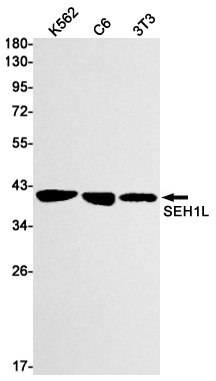

Anti-SEH1L antibody [R03-9E2] (STJA0034848)
SPECIFICATIONS
ClonalityMonoclonal
HostRabbit
ConjugationUnconjugated
IsotypeIgG
ImmunogenA synthetic peptide of mouse SEH1L
General Information
| Short Description | Rabbit monoclonal anti-SEH1L for use in WB and IP in Human, Mouse and Rat samples. Datasheet included with dilution recommendations, and related reagents. |
| Applications | WB/IP |
| Host | Rabbit |
| Reactivity | Human/Mouse/Rat |
| Note | STRICTLY FOR FURTHER SCIENTIFIC RESEARCH USE ONLY (RUO). MUST NOT TO BE USED IN DIAGNOSTIC OR THERAPEUTIC APPLICATIONS. |
Product Properties
| Clonality | Monoclonal |
| Clone ID | R03-9E2 |
| Isotype | IgG |
| Conjugation | Unconjugated |
| Concentration | 0.3 mg/mL |
| Purification | Affinity Purified |
| Dilution Range | WB 1:500-1:1000IP 1:20 |
| Formulation | 50mM Tris-Glycine (pH 7.4) , 0.15M NaCl, 40% Glycerol, 0.01% Sodium azide and 0.05% BSA |
| Storage Instruction | Store at 4°C short term. Aliquot and store at-20°C long term. Avoid freeze/thaw cycles. |
Target Information
| Gene Symbol | Seh1l |
| Gene ID | 72124 |
| Uniprot ID | SEH1_MOUSE |
| Immunogen | A synthetic peptide of mouse SEH1L |
Additional Info
| Function | Component of the Nup107-160 subcomplex of the nuclear pore complex (NPC). The Nup107-160 subcomplex is required for the assembly of a functional NPC. The Nup107-160 subcomplex is also required for normal kinetochore microtubule attachment, mitotic progression and chromosome segregation. This subunit plays a role in recruitment of the Nup107-160 subcomplex to the kinetochore. As a component of the GATOR2 complex, functions as an activator of the amino acid-sensing branch of the mTORC1 signaling pathway. The GATOR2 complex indirectly activates mTORC1 through the inhibition of the GATOR1 subcomplex. GATOR2 probably acts as an E3 ubiquitin-protein ligase toward GATOR1. In the presence of abundant amino acids, the GATOR2 complex mediates ubiquitination of the NPRL2 core component of the GATOR1 complex, leading to GATOR1 inactivation. In the absence of amino acids, GATOR2 is inhibited, activating the GATOR1 complex. Within the GATOR2 complex, SEC13 and SEH1L are required to stabilize the complex. |
| Protein Name | Nucleoporin Seh1Gator2 Complex Protein Seh1Nup107-160 Subcomplex Subunit Seh1 |
| Database Links | Reactome: R-MMU-141444Reactome: -MMU-159227Reactome: -MMU-159230Reactome: -MMU-159231Reactome: -MMU-159236Reactome: -MMU-170822Reactome: -MMU-191859Reactome: -MMU-2467813Reactome: -MMU-2500257Reactome: -MMU-3108214Reactome: -MMU-3232142Reactome: -MMU-3301854Reactome: -MMU-3371453Reactome: -MMU-4085377Reactome: -MMU-4551638Reactome: -MMU-4570464Reactome: -MMU-4615885Reactome: -MMU-5578749Reactome: -MMU-5663220Reactome: -MMU-68877Reactome: -MMU-9615933Reactome: -MMU-9639288Reactome: -MMU-9648025 |
| Cellular Localisation | ChromosomeCentromereKinetochoreNucleusNuclear Pore ComplexLysosome Membrane |
| Alternative Antibody Names | Anti-Nucleoporin Seh1 antibodyAnti-Gator2 Complex Protein Seh1 antibodyAnti-Nup107-160 Subcomplex Subunit Seh1 antibodyAnti-Seh1l antibody |
Information sourced from Uniprot.org