


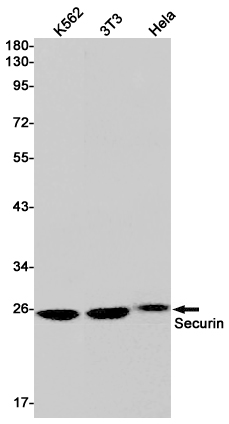
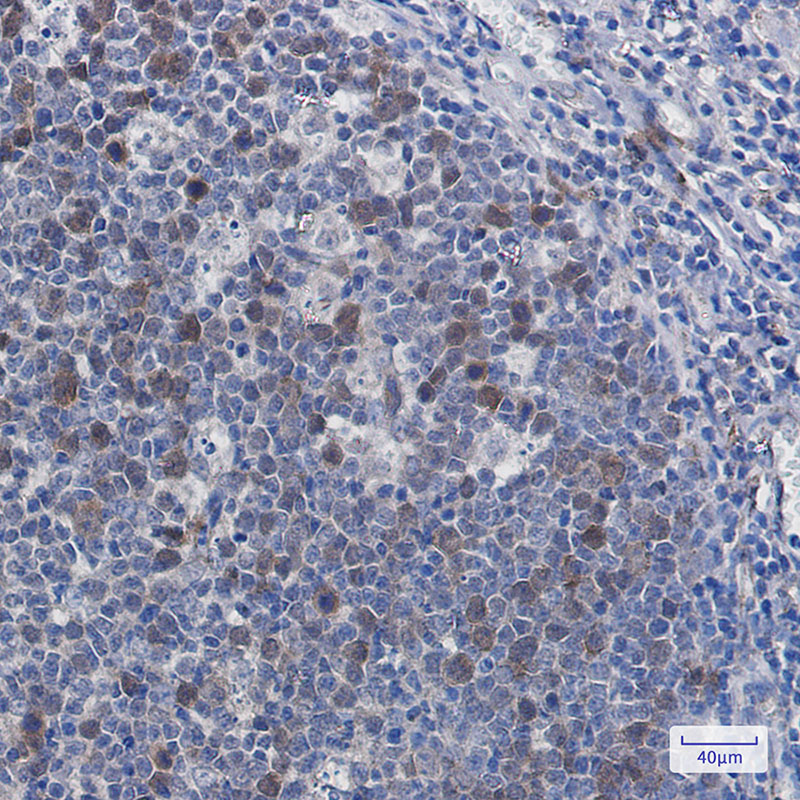

Anti-Securin antibody [R09-6J7] (STJA0034847)
SPECIFICATIONS
ClonalityMonoclonal
HostRabbit
ConjugationUnconjugated
IsotypeIgG
ImmunogenA synthetic peptide of human Securin
General Information
| Short Description | Rabbit monoclonal anti-Securin for use in WB, IHC-P and IP in Human and Mouse samples. Datasheet included with dilution recommendations, and related reagents. |
| Applications | WB/IHC-P/IP |
| Host | Rabbit |
| Reactivity | Human/Mouse |
| Note | STRICTLY FOR FURTHER SCIENTIFIC RESEARCH USE ONLY (RUO). MUST NOT TO BE USED IN DIAGNOSTIC OR THERAPEUTIC APPLICATIONS. |
Product Properties
| Clonality | Monoclonal |
| Clone ID | R09-6J7 |
| Isotype | IgG |
| Conjugation | Unconjugated |
| Concentration | 0.3 mg/mL |
| Purification | Affinity Purified |
| Dilution Range | WB 1:500-1:1000IHC 1:50-1:100IP 1:20 |
| Formulation | 50mM Tris-Glycine (pH 7.4) , 0.15M NaCl, 40% Glycerol, 0.01% Sodium azide and 0.05% BSA |
| Storage Instruction | Store at 4°C short term. Aliquot and store at-20°C long term. Avoid freeze/thaw cycles. |
Target Information
| Gene Symbol | PTTG1 |
| Gene ID | 9232 |
| Uniprot ID | PTTG1_HUMAN |
| Immunogen | A synthetic peptide of human Securin |
Additional Info
| Tissue Specificity | Expressed at low level in most tissues, except in adult testis, where it is highly expressed. Overexpressed in many patients suffering from pituitary adenomas, primary epithelial neoplasias, and esophageal cancer. |
| Post Translational Modifications | Phosphorylated at Ser-165 by CDK1 during mitosis. Phosphorylated in vitro by ds-DNA kinase. Ubiquitinated through 'Lys-11' linkage of ubiquitin moieties by the anaphase promoting complex (APC) at the onset of anaphase, conducting to its degradation. 'Lys-11'-linked ubiquitination is mediated by the E2 ligase UBE2C/UBCH10. |
| Function | Regulatory protein, which plays a central role in chromosome stability, in the p53/TP53 pathway, and DNA repair. Probably acts by blocking the action of key proteins. During the mitosis, it blocks Separase/ESPL1 function, preventing the proteolysis of the cohesin complex and the subsequent segregation of the chromosomes. At the onset of anaphase, it is ubiquitinated, conducting to its destruction and to the liberation of ESPL1. Its function is however not limited to a blocking activity, since it is required to activate ESPL1. Negatively regulates the transcriptional activity and related apoptosis activity of TP53. The negative regulation of TP53 may explain the strong transforming capability of the protein when it is overexpressed. May also play a role in DNA repair via its interaction with Ku, possibly by connecting DNA damage-response pathways with sister chromatid separation. |
| Protein Name | SecurinEsp1-Associated ProteinPituitary Tumor-Transforming Gene 1 ProteinTumor-Transforming Protein 1Hpttg |
| Database Links | Reactome: R-HSA-174154Reactome: R-HSA-174178Reactome: R-HSA-2467813 |
| Cellular Localisation | CytoplasmNucleus |
| Alternative Antibody Names | Anti-Securin antibodyAnti-Esp1-Associated Protein antibodyAnti-Pituitary Tumor-Transforming Gene 1 Protein antibodyAnti-Tumor-Transforming Protein 1 antibodyAnti-Hpttg antibodyAnti-PTTG1 antibodyAnti-EAP1 antibodyAnti-PTTG antibodyAnti-TUTR1 antibody |
Information sourced from Uniprot.org