

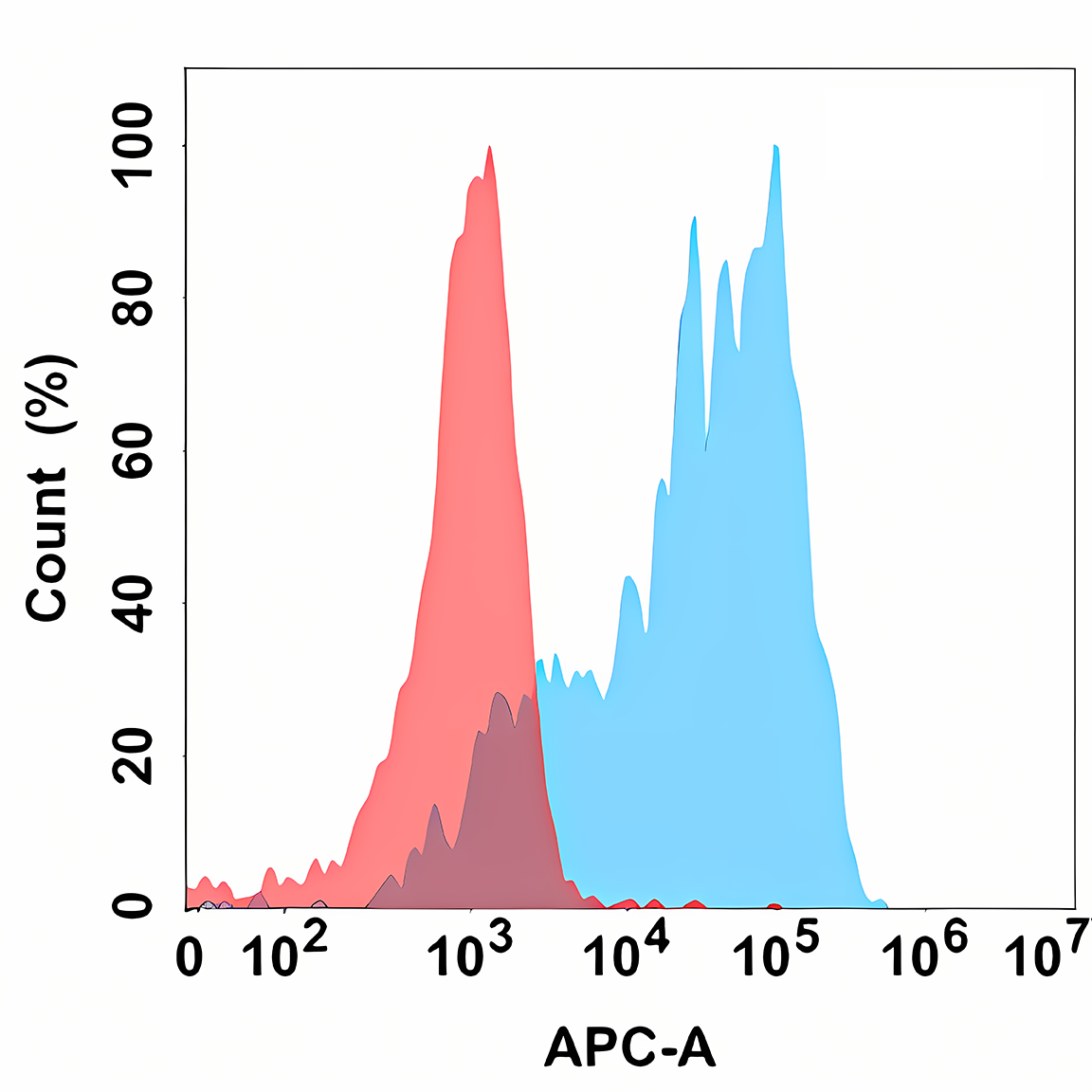

Anti-SCF antibody [DM194] (STJA0038160)
SPECIFICATIONS
ClonalityMonoclonal
HostRabbit
ConjugationUnconjugated
IsotypeIgG
ImmunogenRecombinant human SCF protein
General Information
| Short Description | Rabbit monoclonal anti-SCF for use in FC and ELISA in Human samples. Datasheet included with dilution recommendations, and related reagents. |
| Applications | FC/ELISA |
| Host | Rabbit |
| Reactivity | Human |
| Note | STRICTLY FOR FURTHER SCIENTIFIC RESEARCH USE ONLY (RUO). MUST NOT TO BE USED IN DIAGNOSTIC OR THERAPEUTIC APPLICATIONS. |
Product Properties
| Clonality | Monoclonal |
| Clone ID | DM194 |
| Isotype | IgG |
| Conjugation | Unconjugated |
| Purification | Affinity Chromatography |
| Dilution Range | FC 1:50-1:100ELISA 1:10000 |
| Formulation | Liquid in PBS containing 50% glycerol, 0.5% BSA and 0.02% sodium azide, pH 7.3. |
| Storage Instruction | Store at 4°C short term. Aliquot and store at-20°C long term. Avoid freeze/thaw cycles. |
Target Information
| Gene Symbol | KITLG |
| Gene ID | 4254 |
| Uniprot ID | SCF_HUMAN |
| Immunogen | Recombinant human SCF protein |
Additional Info
| Post Translational Modifications | A soluble form (sKITLG) is produced by proteolytic processing of isoform 1 in the extracellular domain. Found in two differentially glycosylated forms, LMW-SCF and HMW-SCF. LMW-SCF is fully N-glycosylated at Asn-145, partially N-glycosylated at Asn-90, O-glycosylated at Ser-167, Thr-168 and Thr-180, and not glycosylated at Asn-97 or Asn-118. HMW-SCF is N-glycosylated at Asn-118, Asn-90 and Asn-145, O-glycosylated at Ser-167, Thr-168 and Thr-180, and not glycosylated at Asn-97. A soluble form exists as a cleavage product of the extracellular domain. |
| Function | Ligand for the receptor-type protein-tyrosine kinase KIT. Plays an essential role in the regulation of cell survival and proliferation, hematopoiesis, stem cell maintenance, gametogenesis, mast cell development, migration and function, and in melanogenesis. KITLG/SCF binding can activate several signaling pathways. Promotes phosphorylation of PIK3R1, the regulatory subunit of phosphatidylinositol 3-kinase, and subsequent activation of the kinase AKT1. KITLG/SCF and KIT also transmit signals via GRB2 and activation of RAS, RAF1 and the MAP kinases MAPK1/ERK2 and/or MAPK3/ERK1. KITLG/SCF and KIT promote activation of STAT family members STAT1, STAT3 and STAT5. KITLG/SCF and KIT promote activation of PLCG1, leading to the production of the cellular signaling molecules diacylglycerol and inositol 1,4,5-trisphosphate. KITLG/SCF acts synergistically with other cytokines, probably interleukins. |
| Protein Name | Kit LigandMast Cell Growth FactorMgfStem Cell FactorScfC-Kit Ligand Cleaved Into - Soluble Kit LigandSkitlg |
| Database Links | Reactome: R-HSA-1257604 P21583-1Reactome: R-HSA-1433557 P21583-1Reactome: R-HSA-1433559 P21583-1Reactome: R-HSA-2219530 P21583-1Reactome: R-HSA-5673001 P21583-1Reactome: R-HSA-6811558 P21583-1Reactome: R-HSA-9856649 P21583-1 |
| Cellular Localisation | Isoform 1: Cell MembraneSingle-Pass Type I Membrane ProteinIsoform 2: CytoplasmCytoplasmCytoskeletonCell MembraneCell ProjectionLamellipodiumFilopodiumSoluble Kit Ligand: Secreted |
| Alternative Antibody Names | Anti-Kit Ligand antibodyAnti-Mast Cell Growth Factor antibodyAnti-Mgf antibodyAnti-Stem Cell Factor antibodyAnti-Scf antibodyAnti-C-Kit Ligand Cleaved Into - Soluble Kit Ligand antibodyAnti-Skitlg antibodyAnti-KITLG antibodyAnti-MGF antibodyAnti-SCF antibody |
Information sourced from Uniprot.org