

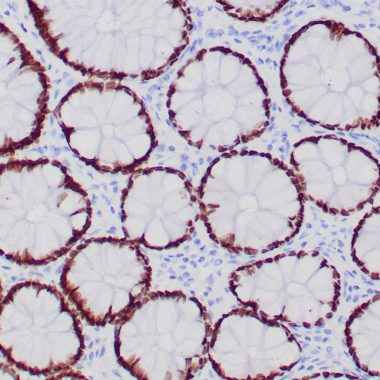

Anti-SATB2 antibody (150-350aa) [ZR167] (STJ180539)
SPECIFICATIONS
ClonalityMonoclonal
HostRabbit
ConjugationUnconjugated
IsotypeIgG
ImmunogenRecombinant fragment (around aa150-350) of human SATB2 protein
General Information
| Short Description | Rabbit monoclonal SATB2 (150-350aa) antibody for use in IHC-P in human samples. Datasheet included with dilution recommendations, and related reagents. |
| Applications | IHC-P |
| Host | Rabbit |
| Reactivity | Human |
| Note | STRICTLY FOR FURTHER SCIENTIFIC RESEARCH USE ONLY (RUO). MUST NOT TO BE USED IN DIAGNOSTIC OR THERAPEUTIC APPLICATIONS. |
Product Properties
| Clonality | Monoclonal |
| Clone ID | ZR167 |
| Isotype | IgG |
| Conjugation | Unconjugated |
| Purification | Affinity purified |
| Dilution Range | 1:100-200 |
| Formulation | Tris-HCI buffer containing stabilizing protein (BSA) and <0.1% ProClin |
| Storage Instruction | Store at 2‐8°C for up to 24 months. Predilute: Ready to use, no reconstitution necessary. Concentrate: Use dilution range and appropriate lab‐standardized diluent. Stability after dilution: 7 days at 24°C, 3 months at 2‐8°C, 6months at ‐20°C. |
Target Information
| Gene Symbol | SATB2 |
| Gene ID | 23314 |
| Uniprot ID | SATB2_HUMAN |
| Immunogen | Recombinant fragment (around aa150-350) of human SATB2 protein |
| Immunogen Region | 150-350aa |
| Specificity | Positive control: Colon or colon cancer |
Additional Info
| Tissue Specificity | High expression in adult brain, moderate expression in fetal brain, and weak expression in adult liver, kidney, and spinal cord and in select brain regions, including amygdala, corpus callosum, caudate nucleus, and hippocampus. |
| Post Translational Modifications | Sumoylated by PIAS1. Sumoylation promotes nuclear localization, but represses transcription factor activity. |
| Function | Binds to DNA, at nuclear matrix- or scaffold-associated regions. Thought to recognize the sugar-phosphate structure of double-stranded DNA. Transcription factor controlling nuclear gene expression, by binding to matrix attachment regions (MARs) of DNA and inducing a local chromatin-loop remodeling. Acts as a docking site for several chromatin remodeling enzymes and also by recruiting corepressors (HDACs) or coactivators (HATs) directly to promoters and enhancers. Required for the initiation of the upper-layer neurons (UL1) specific genetic program and for the inactivation of deep-layer neurons (DL) and UL2 specific genes, probably by modulating BCL11B expression. Repressor of Ctip2 and regulatory determinant of corticocortical connections in the developing cerebral cortex. May play an important role in palate formation. Acts as a molecular node in a transcriptional network regulating skeletal development and osteoblast differentiation. |
| Protein Name | Dna-Binding Protein Satb2Special At-Rich Sequence-Binding Protein 2 |
| Database Links | Reactome: R-HSA-4551638Reactome: R-HSA-8940973 |
| Cellular Localisation | Nucleus Matrix |
| Alternative Antibody Names | Anti-Dna-Binding Protein Satb2 antibodyAnti-Special At-Rich Sequence-Binding Protein 2 antibodyAnti-SATB2 antibodyAnti-KIAA1034 antibody |
Information sourced from Uniprot.org