
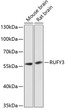


Anti-RUFY3 antibody (1-65) (STJ114762)
SPECIFICATIONS
ClonalityPolyclonal
HostRabbit
ConjugationUnconjugated
IsotypeIgG
General Information
| Short Description | Rabbit polyclonal RUFY3 (1-65) antibody for use in WB and ELISA in mouse and rat samples. Datasheet included with dilution recommendations, and related reagents. |
| Applications | WB/ELISA |
| Host | Rabbit |
| Reactivity | Mouse/Rat |
| Note | STRICTLY FOR FURTHER SCIENTIFIC RESEARCH USE ONLY (RUO). MUST NOT TO BE USED IN DIAGNOSTIC OR THERAPEUTIC APPLICATIONS. |
Product Properties
| Clonality | Polyclonal |
| Isotype | IgG |
| Conjugation | Unconjugated |
| Concentration | Lot specific |
| Purification | Affinity purification |
| Dilution Range | WB:1:500-1:2000ELISA:Recommended starting concentration is 1 Mu g/mL. Please optimize the concentration based on your specific assay requirements. |
| Formulation | PBS with 0.01% Thimerosal, 50% Glycerol, pH 7.3. |
| Storage Instruction | Store at-20°C for up to 1 year from the date of receipt, and avoid repeat freeze-thaw cycles. |
Target Information
| Gene Symbol | RUFY3 |
| Gene ID | 22902 |
| Uniprot ID | RUFY3_HUMAN |
| Immunogen Region | 1-65 |
| Immunogen Sequence | MSALTPPTDMPTPTTDKITQ AAMETIYLCKFRVSMDGEWL CLRELDDISLTPDPEPTHED PNYLM |
| Specificity | Recombinant fusion protein containing a sequence corresponding to amino acids 1-65 of human RUFY3 (NP_055776.1). |
Additional Info
| Tissue Specificity | Overexpressed in gastric cancer cells and tissues (at protein level). |
| Post Translational Modifications | Phosphorylated by PAK1. Isoform 1 is partially phosphorylated. |
| Function | ARL8 effector that promotes the coupling of endolysosomes to dynein-dynactin for retrograde transport along microtubules. Acts by binding both GTP-bound ARL8 and dynein-dynactin. In nonneuronal cells, promotes concentration of endolysosomes in the juxtanuclear area. In hippocampal neurons, drives retrograde transport of endolysosomes from the axon to the soma. Plays a role in the generation of neuronal polarity formation and axon growth. Implicated in the formation of a single axon by developing neurons. May inhibit the formation of additional axons by inhibition of PI3K in minor neuronal processes. Plays a role in the formation of F-actin-enriched protrusive structures at the cell periphery. Plays a role in cytoskeletal organization by regulating the subcellular localization of FSCN1 and DBN1 at axonal growth cones. |
| Protein Name | Protein Rufy3Run And Fyve Domain-Containing Protein 3Rap2-Interacting Protein XRipxSingle Axon-Regulated ProteinSingar |
| Database Links | |
| Cellular Localisation | CytoplasmEndomembrane SystemCell ProjectionInvadopodiumPerikaryonGrowth ConeFilopodiumLamellipodiumLysosomeColocalizes With Pak1F-ActinMyosins And Integrins In Invadopodia At The Cell PeripheryColocalizes With Ras-Related Rab-5 Proteins In Cytoplasmic VesiclesAccumulates In Axon Growth Cones In A F-Actin-Dependent MannerColocalizes With Fscn1 And F-Actin At Filipodia And Lamellipodia Of Axonal Growth ConesColocalizes With Dbn1 And F-Actin At Transitional Domain Of The Axonal Growth ConeRecruitment To Endolysosomes Partially Depends Upon The Presence Of Arl8 |
| Alternative Antibody Names | Anti-Protein Rufy3 antibodyAnti-Run And Fyve Domain-Containing Protein 3 antibodyAnti-Rap2-Interacting Protein X antibodyAnti-Ripx antibodyAnti-Single Axon-Regulated Protein antibodyAnti-Singar antibodyAnti-RUFY3 antibodyAnti-KIAA0871 antibody |
Information sourced from Uniprot.org