

Anti-ROS1 antibody (Cytoplasmic Domain) [ZR400] (STJ180593)
SPECIFICATIONS
ClonalityMonoclonal
HostRabbit
ConjugationUnconjugated
IsotypeIgG
ImmunogenRecombinant fragment corresponding to the cytoplasmic domain of human ROS1 protein
General Information
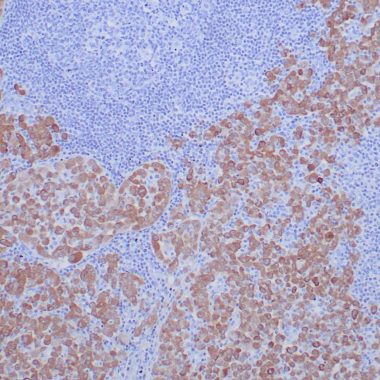
| Short Description | Rabbit monoclonal ROS1 (Cytoplasmic Domain) antibody for use in IHC-P in human samples. Datasheet included with dilution recommendations, and related reagents. |
| Applications | IHC-P |
| Host | Rabbit |
| Reactivity | Human |
| Note | STRICTLY FOR FURTHER SCIENTIFIC RESEARCH USE ONLY (RUO). MUST NOT TO BE USED IN DIAGNOSTIC OR THERAPEUTIC APPLICATIONS. |
Product Properties
| Clonality | Monoclonal |
| Clone ID | ZR400 |
| Isotype | IgG |
| Conjugation | Unconjugated |
| Purification | Affinity purified |
| Dilution Range | 1:100-200 |
| Formulation | Tris-HCI buffer containing stabilizing protein (BSA) and <0.1% ProClin |
| Storage Instruction | Store at 2‐8°C for up to 24 months. Predilute: Ready to use, no reconstitution necessary. Concentrate: Use dilution range and appropriate lab‐standardized diluent. Stability after dilution: 7 days at 24°C, 3 months at 2‐8°C, 6months at ‐20°C. |
Target Information
| Gene Symbol | ROS1 |
| Gene ID | 6098 |
| Uniprot ID | ROS1_HUMAN |
| Immunogen | Recombinant fragment corresponding to the cytoplasmic domain of human ROS1 protein |
| Immunogen Region | Cytoplasmic Domain |
| Specificity | Positive Control: Human brain, lung adenocarcinoma or primary glioblastoma |
Additional Info
| Tissue Specificity | Expressed in brain. Expression is increased in primary gliomas. |
| Post Translational Modifications | Phosphorylated. Probably autophosphorylates. Phosphorylation at Tyr-2274 is required for the interaction with PTPN6 that mediates ROS1 dephosphorylation. Phosphorylation at Tyr-2274 stimulates the kinase activity and the activation of the ERK1 signaling cascade. Phosphorylation at Tyr-2274 and/or Tyr-2334 recruits PTPN11. |
| Function | Receptor tyrosine kinase (RTK) that plays a role in epithelial cell differentiation and regionalization of the proximal epididymal epithelium. NELL2 is an endogenous ligand for ROS1. Upon endogenous stimulation by NELL2, ROS1 activates the intracellular signaling pathway and triggers epididymal epithelial differentiation and subsequent sperm maturation. May activate several downstream signaling pathways related to cell differentiation, proliferation, growth and survival including the PI3 kinase-mTOR signaling pathway. Mediates the phosphorylation of PTPN11, an activator of this pathway. May also phosphorylate and activate the transcription factor STAT3 to control anchorage-independent cell growth. Mediates the phosphorylation and the activation of VAV3, a guanine nucleotide exchange factor regulating cell morphology. May activate other downstream signaling proteins including AKT1, MAPK1, MAPK3, IRS1 and PLCG2. |
| Protein Name | Proto-Oncogene Tyrosine-Protein Kinase RosProto-Oncogene C-RosProto-Oncogene C-Ros-1Receptor Tyrosine Kinase C-Ros Oncogene 1C-Ros Receptor Tyrosine Kinase |
| Database Links | |
| Cellular Localisation | Cell MembraneSingle-Pass Type I Membrane Protein |
| Alternative Antibody Names | Anti-Proto-Oncogene Tyrosine-Protein Kinase Ros antibodyAnti-Proto-Oncogene C-Ros antibodyAnti-Proto-Oncogene C-Ros-1 antibodyAnti-Receptor Tyrosine Kinase C-Ros Oncogene 1 antibodyAnti-C-Ros Receptor Tyrosine Kinase antibodyAnti-ROS1 antibodyAnti-MCF3 antibodyAnti-ROS antibody |
Information sourced from Uniprot.org