

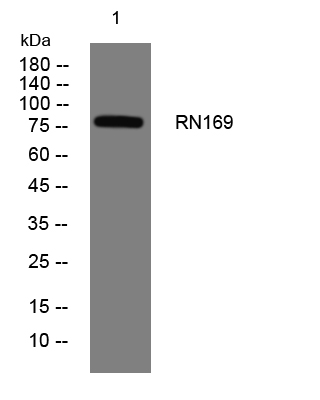
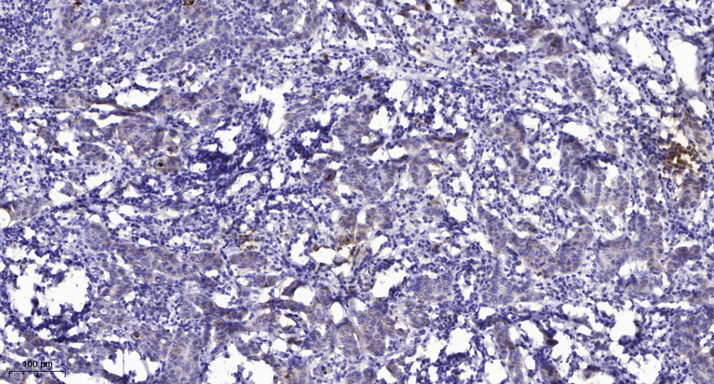

Anti-RNF169 antibody (123-173 aa) (STJ195525)
SPECIFICATIONS
ClonalityPolyclonal
HostRabbit
ConjugationUnconjugated
IsotypeIgG
ImmunogenSynthesized peptide derived from the human RN169 at the amino acid range 123-173
General Information
| Short Description | Rabbit polyclonal anti-E3 ubiquitin-protein ligase RNF169 (123-173 aa) for use in WB, ELISA and IHC in Human and Mouse samples. Datasheet included with dilution recommendations, and related reagents. |
| Applications | WB/ELISA/IHC |
| Host | Rabbit |
| Reactivity | Human/Mouse |
| Note | STRICTLY FOR FURTHER SCIENTIFIC RESEARCH USE ONLY (RUO). MUST NOT TO BE USED IN DIAGNOSTIC OR THERAPEUTIC APPLICATIONS. |
Product Properties
| Clonality | Polyclonal |
| Isotype | IgG |
| Conjugation | Unconjugated |
| Concentration | 1 mg/mL |
| Purification | The antibody was affinity-purified from rabbit antiserum by affinity-chromatography using epitope-specific immunogen. |
| Dilution Range | WB 1:500-2000IHC-P 1:50-300ELISA 2000-20000 |
| Formulation | Liquid in PBS containing 50% Glycerol, 0.5% BSA and 0.02% Sodium Azide. |
| Storage Instruction | Store at-20°C for up to 1 year from the date of receipt, and avoid repeat freeze-thaw cycles. |
Target Information
| Gene Symbol | RNF169 |
| Gene ID | 254225 |
| Uniprot ID | RN169_HUMAN |
| Immunogen | Synthesized peptide derived from the human RN169 at the amino acid range 123-173 |
| Immunogen Region | 123-173 aa |
| Specificity | This antibody detects endogenous levels of RN169 at Human/Mouse |
Additional Info
| Function | Probable E3 ubiquitin-protein ligase that acts as a regulator of double-strand breaks (DSBs) repair following DNA damage. Functions in a non-canonical fashion to harness RNF168-mediated protein recruitment to DSB-containing chromatin, thereby contributing to regulation of DSB repair pathway utilization. Once recruited to DSB repair sites by recognizing and binding ubiquitin catalyzed by RNF168, competes with TP53BP1 and BRCA1 for association with RNF168-modified chromatin, thereby favouring homologous recombination repair (HRR) and single-strand annealing (SSA) instead of non-homologous end joining (NHEJ) mediated by TP53BP1. E3 ubiquitin-protein ligase activity is not required for regulation of DSBs repair. |
| Protein Name | E3 Ubiquitin-Protein Ligase Rnf169Ring Finger Protein 169Ring-Type E3 Ubiquitin Transferase Rnf169 |
| Database Links | |
| Cellular Localisation | ChromosomeNucleusNucleoplasmLocalizes To Sites Of Double-Strand Breaks (Dsbs) Following Dna DamageRecruited To Dsbs Via Recognition Of Rnf168-Dependent Ubiquitin Products |
| Alternative Antibody Names | Anti-E3 Ubiquitin-Protein Ligase Rnf169 antibodyAnti-Ring Finger Protein 169 antibodyAnti-Ring-Type E3 Ubiquitin Transferase Rnf169 antibodyAnti-RNF169 antibodyAnti-KIAA1991 antibody |
Information sourced from Uniprot.org