


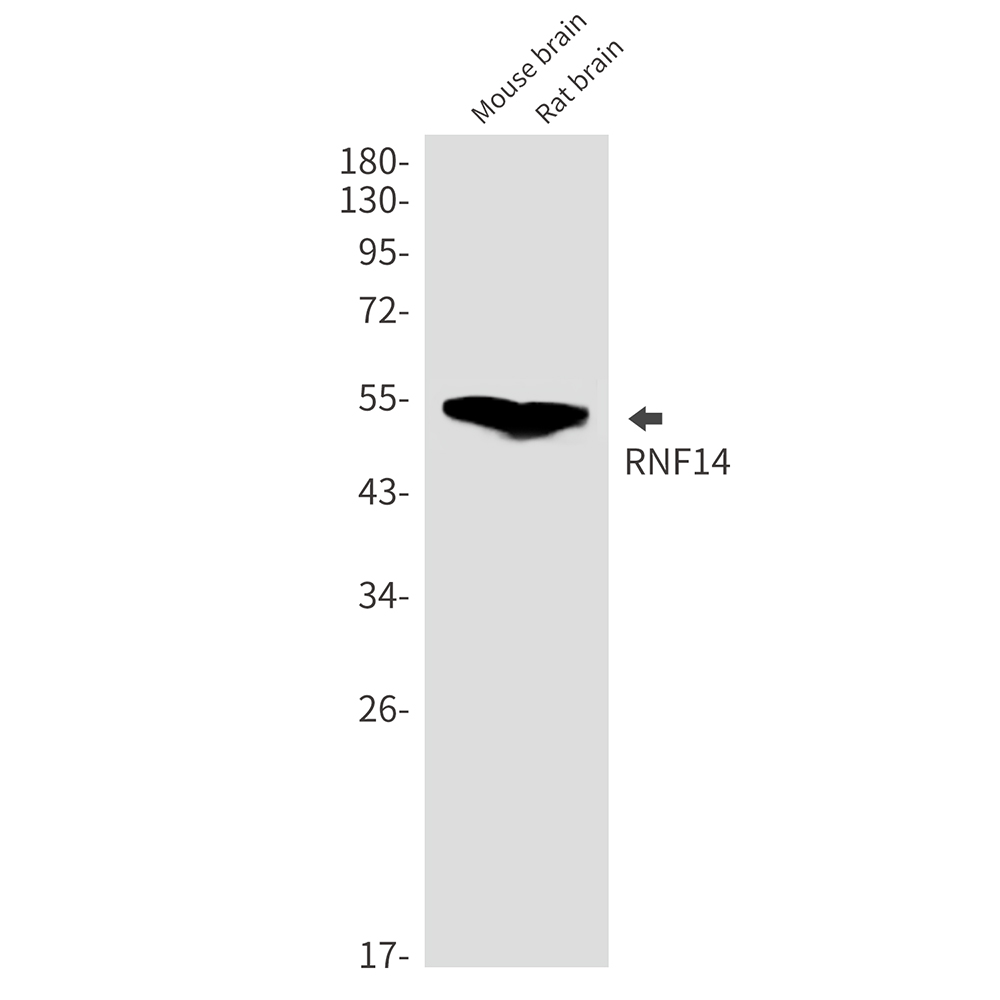
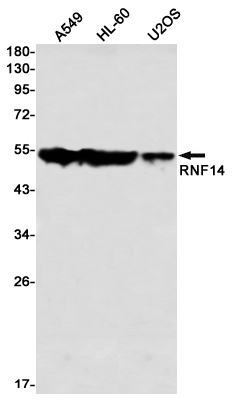

Anti-RNF14 antibody [R01-1H7] (STJA0035352)
SPECIFICATIONS
ClonalityMonoclonal
HostRabbit
ConjugationUnconjugated
IsotypeIgG
ImmunogenA synthetic peptide of human RNF14
General Information
| Short Description | Rabbit monoclonal anti-RNF14 for use in WB in Human, Mouse and Rat samples. Datasheet included with dilution recommendations, and related reagents. |
| Applications | WB |
| Host | Rabbit |
| Reactivity | Human/Mouse/Rat |
| Note | STRICTLY FOR FURTHER SCIENTIFIC RESEARCH USE ONLY (RUO). MUST NOT TO BE USED IN DIAGNOSTIC OR THERAPEUTIC APPLICATIONS. |
Product Properties
| Clonality | Monoclonal |
| Clone ID | R01-1H7 |
| Isotype | IgG |
| Conjugation | Unconjugated |
| Concentration | 0.3 mg/mL |
| Purification | Affinity Purified |
| Dilution Range | WB 1:500-1:1000 |
| Formulation | 50mM Tris-Glycine (pH 7.4) , 0.15M NaCl, 40% Glycerol, 0.01% Sodium azide and 0.05% BSA |
| Storage Instruction | Store at 4°C short term. Aliquot and store at-20°C long term. Avoid freeze/thaw cycles. |
Target Information
| Gene Symbol | RNF14 |
| Gene ID | 9604 |
| Uniprot ID | RNF14_HUMAN |
| Immunogen | A synthetic peptide of human RNF14 |
Additional Info
| Tissue Specificity | Widely expressed. |
| Post Translational Modifications | RING-type zinc finger-dependent and UBE2E2-dependent autoubiquitination. |
| Function | E3 ubiquitin-protein ligase that plays a key role in the RNF14-RNF25 translation quality control pathway, a pathway that takes place when a ribosome has stalled during translation, and which promotes ubiquitination and degradation of translation factors on stalled ribosomes. Recruited to stalled ribosomes by the ribosome collision sensor GCN1 and mediates 'Lys-6'-linked ubiquitination of target proteins, leading to their degradation. Mediates ubiquitination of EEF1A1/eEF1A and ETF1/eRF1 translation factors on stalled ribosomes, leading to their degradation. Also catalyzes ubiquitination of ribosomal proteins RPL0, RPL1, RPL12, RPS13 and RPS17. Specifically required to resolve RNA-protein cross-links caused by reactive aldehydes, which trigger translation stress by stalling ribosomes: acts by catalying 'Lys-6'-linked ubiquitination of RNA-protein cross-links, leading to their removal by the ATP-dependent unfoldase VCP and subsequent degradation by the proteasome. Independently of its function in the response to stalled ribosomes, acts as a regulator of transcription in Wnt signaling via its interaction with TCF transcription factors (TCF7/TCF1, TCF7L1/TCF3 and TCF7L2/TCF4). May also play a role as a coactivator for androgen- and, to a lesser extent, progesterone-dependent transcription. |
| Protein Name | E3 Ubiquitin-Protein Ligase Rnf14Androgen Receptor-Associated Protein 54Hfb30Ring Finger Protein 14 |
| Database Links | Reactome: R-HSA-983168 |
| Cellular Localisation | CytoplasmNucleus |
| Alternative Antibody Names | Anti-E3 Ubiquitin-Protein Ligase Rnf14 antibodyAnti-Androgen Receptor-Associated Protein 54 antibodyAnti-Hfb30 antibodyAnti-Ring Finger Protein 14 antibodyAnti-RNF14 antibodyAnti-ARA54 antibodyAnti-HRIHFB2038 antibody |
Information sourced from Uniprot.org