
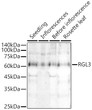


Anti-RGL3 antibody (1-106 aa) (STJ11104874)
SPECIFICATIONS
ClonalityPolyclonal
HostRabbit
ConjugationUnconjugated
IsotypeIgG
General Information
| Short Description | Rabbit polyclonal RGL3 (1-106 aa) antibody for use in WB and ELISA in a.thaliana samples. Datasheet included with dilution recommendations, and related reagents. |
| Applications | WB/ELISA |
| Host | Rabbit |
| Reactivity | A.thaliana |
| Note | STRICTLY FOR FURTHER SCIENTIFIC RESEARCH USE ONLY (RUO). MUST NOT TO BE USED IN DIAGNOSTIC OR THERAPEUTIC APPLICATIONS. |
Product Properties
| Clonality | Polyclonal |
| Isotype | IgG |
| Conjugation | Unconjugated |
| Concentration | Lot specific |
| Purification | Affinity purification |
| Dilution Range | WB:1:100-1:500ELISA:Recommended starting concentration is 1 Mu g/mL. Please optimize the concentration based on your specific assay requirements. |
| Formulation | PBS with 0.05% Proclin300, 50% Glycerol, pH 7.3. |
| Storage Instruction | Store at-20°C for up to 1 year from the date of receipt, and avoid repeat freeze-thaw cycles. |
Target Information
| Immunogen Region | 1-106 aa |
| Immunogen Sequence | MKRSHQETSVEEEAPSMVEK LENGCGGGGDDNMDEFLAVL GYKVRSSDMADVAQKLEQLE MVLSNDIASSSNAFNDTVHY NPSDLSGWAQSMLSDLNYYP DLDPNR |
| Specificity | Recombinant fusion protein containing a sequence corresponding to amino acids 1-106 of Arabidopsis thaliana RGL3. (NP_197251.1). |
Additional Info
| Background | Encodes a DELLA subfamily member that acts as a negative regulator of GA signaling and as a coactivator of ABI3 to promote seed storage protein biosynthesis during the seed maturation stage. Involved in hyperosmotic salinity response, jasmonic acid mediated signaling pathway, negative regulation of gibberellic acid mediated signaling pathway, negative regulation of seed germination, regulation of DNA-templated transcription, regulation of reactive oxygen species metabolic process, regulation of seed dormancy process, response to abscisic acid, response to ethylene, salicylic acid mediated signaling pathway. |
Information sourced from Uniprot.org