

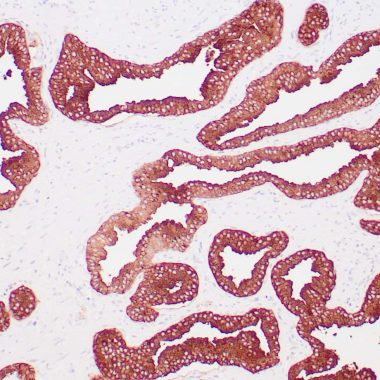

Anti-Recombinant-PSAP antibody [ZM162] (STJ180370)
SPECIFICATIONS
ClonalityMonoclonal
HostMouse
ConjugationUnconjugated
IsotypeIgG1k
ImmunogenRecombinant human ACPP fragment
General Information
| Short Description | Mouse monoclonal Recombinant-PSAP antibody for use in IHC-P in human samples. Datasheet included with dilution recommendations, and related reagents. |
| Applications | IHC-P |
| Host | Mouse |
| Reactivity | Human |
| Note | STRICTLY FOR FURTHER SCIENTIFIC RESEARCH USE ONLY (RUO). MUST NOT TO BE USED IN DIAGNOSTIC OR THERAPEUTIC APPLICATIONS. |
Product Properties
| Clonality | Monoclonal |
| Clone ID | ZM162 |
| Isotype | IgG1k |
| Conjugation | Unconjugated |
| Purification | Affinity purified |
| Dilution Range | 1:100‐200 |
| Formulation | Tris-HCI buffer containing stabilizing protein (BSA) and <0.1% ProClin |
| Storage Instruction | Store at 2‐8°C for up to 24 months. Predilute: Ready to use, no reconstitution necessary. Concentrate: Use dilution range and appropriate lab‐standardized diluent. Stability after dilution: 7 days at 24°C, 3 months at 2‐8°C, 6months at ‐20°C. |
Target Information
| Gene Symbol | PSAP |
| Gene ID | 5660 |
| Uniprot ID | SAP_HUMAN |
| Immunogen | Recombinant human ACPP fragment |
| Specificity | Positive control: Human prostate |
Additional Info
| Post Translational Modifications | The lysosomal precursor is proteolytically processed to 4 small peptides, which are similar to each other and are sphingolipid hydrolase activator proteins. N-linked glycans show a high degree of microheterogeneity. The one residue extended Saposin-B-Val is only found in 5% of the chains. |
| Function | Saposin-A and saposin-C stimulate the hydrolysis of glucosylceramide by beta-glucosylceramidase and galactosylceramide by beta-galactosylceramidase. Saposin-C apparently acts by combining with the enzyme and acidic lipid to form an activated complex, rather than by solubilizing the substrate. Saposin-B stimulates the hydrolysis of galacto-cerebroside sulfate by arylsulfatase A, GM1 gangliosides by beta-galactosidase and globotriaosylceramide by alpha-galactosidase A. Saposin-B forms a solubilizing complex with the substrates of the sphingolipid hydrolases. Saposin-D is a specific sphingomyelin phosphodiesterase activator. Prosaposin: Behaves as a myelinotrophic and neurotrophic factor, these effects are mediated by its G-protein-coupled receptors, GPR37 and GPR37L1, undergoing ligand-mediated internalization followed by ERK phosphorylation signaling. Saposins are specific low-molecular mass non-enzymic proteins, they participate in the lysosomal degradation of sphingolipids, which takes place by the sequential action of specific hydrolases. |
| Protein Name | ProsaposinProactivator Polypeptide Cleaved Into - Saposin-AProtein A - Saposin-B-Val - Saposin-BCerebroside Sulfate ActivatorCsactDispersinSphingolipid Activator Protein 1Sap-1Sulfatide/Gm1 Activator - Saposin-CA1 ActivatorCo-Beta-GlucosidaseGlucosylceramidase ActivatorSphingolipid Activator Protein 2Sap-2 - Saposin-DComponent CProtein C |
| Database Links | Reactome: R-HSA-114608Reactome: R-HSA-375276Reactome: R-HSA-418594Reactome: R-HSA-6798695Reactome: R-HSA-9840310 |
| Cellular Localisation | LysosomeProsaposin: SecretedSecreted As A Fully Glycosylated 70 Kda Protein Composed Of Complex Glycans |
| Alternative Antibody Names | Anti-Prosaposin antibodyAnti-Proactivator Polypeptide Cleaved Into - Saposin-A antibodyAnti-Protein A - Saposin-B-Val - Saposin-B antibodyAnti-Cerebroside Sulfate Activator antibodyAnti-Csact antibodyAnti-Dispersin antibodyAnti-Sphingolipid Activator Protein 1 antibodyAnti-Sap-1 antibodyAnti-Sulfatide/Gm1 Activator - Saposin-C antibodyAnti-A1 Activator antibodyAnti-Co-Beta-Glucosidase antibodyAnti-Glucosylceramidase Activator antibodyAnti-Sphingolipid Activator Protein 2 antibodyAnti-Sap-2 - Saposin-D antibodyAnti-Component C antibodyAnti-Protein C antibodyAnti-PSAP antibodyAnti-GLBA antibodyAnti-SAP1 antibody |
Information sourced from Uniprot.org