

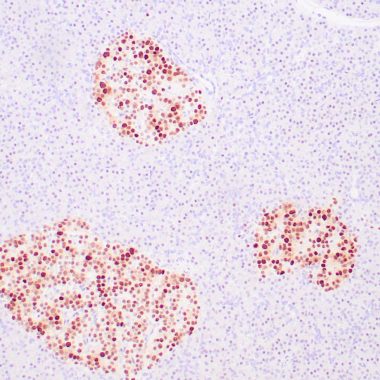

Anti-Recombinant-INSM1 antibody (81-125aa) [A8] (STJ180278)
SPECIFICATIONS
ClonalityMonoclonal
HostMouse
ConjugationUnconjugated
IsotypeIgG1k
ImmunogenAmino acid 81-125 at the N-terminus of human INSM
General Information
| Short Description | Mouse monoclonal Recombinant-INSM1 (81-125aa) antibody for use in IHC-P in human samples. Datasheet included with dilution recommendations, and related reagents. |
| Applications | IHC-P |
| Host | Mouse |
| Reactivity | Human |
| Note | STRICTLY FOR FURTHER SCIENTIFIC RESEARCH USE ONLY (RUO). MUST NOT TO BE USED IN DIAGNOSTIC OR THERAPEUTIC APPLICATIONS. |
Product Properties
| Clonality | Monoclonal |
| Clone ID | A8 |
| Isotype | IgG1k |
| Conjugation | Unconjugated |
| Purification | Affinity purified |
| Dilution Range | 1:100 |
| Formulation | Tris-HCI buffer containing stabilizing protein (BSA) and <0.1% ProClin |
| Storage Instruction | Store at 2‐8°C for up to 24 months. Predilute: Ready to use, no reconstitution necessary. Concentrate: Use dilution range and appropriate lab‐standardized diluent. Stability after dilution: 7 days at 24°C, 3 months at 2‐8°C, 6months at ‐20°C. |
Target Information
| Gene Symbol | INSM1 |
| Gene ID | 3642 |
| Uniprot ID | INSM1_HUMAN |
| Immunogen | Amino acid 81-125 at the N-terminus of human INSM |
| Immunogen Region | 81-125aa |
| Specificity | Positive control: Neuroendocrine tumor |
Additional Info
| Tissue Specificity | Expressed in pancreatic duct cells. Expressed in several tumor cell lines of neuroendocrine origin including pheochromocytoma, medullary thyroid carcinoma, insulinoma, medulloblastoma, retinoblastoma, pheochromacytoma, medullary thyroid carcinoma and small cell lung carcinoma. |
| Function | Sequence-specific DNA-binding transcriptional regulator that plays a key role in neurogenesis and neuroendocrine cell differentiation during embryonic and/or fetal development. Binds to the consensus sequence 5'-TGTCTCTTGAGGGCGA-3' in target promoters. Acts as a transcriptional repressor of NEUROD1 and INS expression via its interaction with cyclin CCND1 in a cell cycle-independent manner. Negatively regulates skeletal muscle-specific gene expression in endocrine cells of the pituitary by inhibiting the Notch signaling pathway. Represses target gene transcription by recruiting chromatin-modifying factors, such as HDAC1, HDAC2, HDAC3, KDM1A and RCOR1 histone deacetylases. Binds to its own promoter, suggesting autoregulation as a self-control feedback mechanism. Competes with histone H3 for the same binding site on the histone demethylase complex formed by KDM1A and RCOR1, and thereby inhibits demethylation of histone H3 at 'Lys-4'. Promotes the generation and expansion of neuronal basal progenitor cells in the developing neocortex. Involved in the differentiation of endocrine cells of the developing anterior pituitary gland, of the pancreas and intestine, and of sympatho-adrenal cells in the peripheral nervous system. Promotes cell cycle signaling arrest and inhibition of cellular proliferation. |
| Protein Name | Insulinoma-Associated Protein 1Zinc Finger Protein Ia-1 |
| Database Links | Reactome: R-HSA-210746 |
| Cellular Localisation | Nucleus |
| Alternative Antibody Names | Anti-Insulinoma-Associated Protein 1 antibodyAnti-Zinc Finger Protein Ia-1 antibodyAnti-INSM1 antibodyAnti-IA1 antibody |
Information sourced from Uniprot.org