

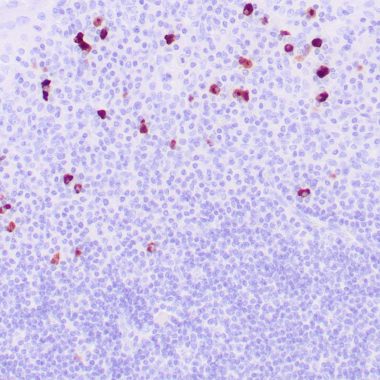

Anti-Recombinant-IgG4 antibody [ZM56] (STJ180612)
SPECIFICATIONS
ClonalityMonoclonal
HostMouse
ConjugationUnconjugated
IsotypeIgG1k
ImmunogenRecombinant human IGHG4 fragment
General Information
| Short Description | Mouse monoclonal Recombinant-IgG4 antibody for use in IHC-P in human samples. Datasheet included with dilution recommendations, and related reagents. |
| Applications | IHC-P |
| Host | Mouse |
| Reactivity | Human |
| Note | STRICTLY FOR FURTHER SCIENTIFIC RESEARCH USE ONLY (RUO). MUST NOT TO BE USED IN DIAGNOSTIC OR THERAPEUTIC APPLICATIONS. |
Product Properties
| Clonality | Monoclonal |
| Clone ID | ZM56 |
| Isotype | IgG1k |
| Conjugation | Unconjugated |
| Purification | Affinity purified |
| Dilution Range | 1:100-200 |
| Formulation | Tris-HCI buffer containing stabilizing protein (BSA) and <0.1% ProClin |
| Storage Instruction | Store at 2‐8°C for up to 24 months. Predilute: Ready to use, no reconstitution necessary. Concentrate: Use dilution range and appropriate lab‐standardized diluent. Stability after dilution: 7 days at 24°C, 3 months at 2‐8°C, 6months at ‐20°C. |
Target Information
| Immunogen | Recombinant human IGHG4 fragment |
| Specificity | Tonsil |
Additional Info
| Background | The regions of relatively constant sequence beyond the variable regions of immunoglobulins are termed constant regions (C regions) and are present in both the heavy and light chains. With very few exceptions, the sites of attachment for carbohydrates on immunoglobulins are located in these C regions. These regions also function to hold the variable regions together by using the disulfide bond between them. The C regions facilitate interaction with the antigen by increasing the maximum rotation of the immunoglobulin arms. Reportedly, a large population of patients with recurrent respiratory tract infection has low IgG4 concentrations. IgG4-related sclerosing disease has been recognized as a systemic disease entity characterized by an elevated serum IgG4 level, sclerosing fibrosis, and diffuse lympho-plasmacytic infiltration with the presence of many IgG4-positive plasma cells. IgG4 is overexpressed in inflammatory pseudo-tumor (IPT) and under expressed in inflammatory myofibroblastic tumor (IMT). In pulmonary nodular lymphoid hyperplasia (PNLH) , there are an increased number of IgG4+ plasma cells. |
Information sourced from Uniprot.org