

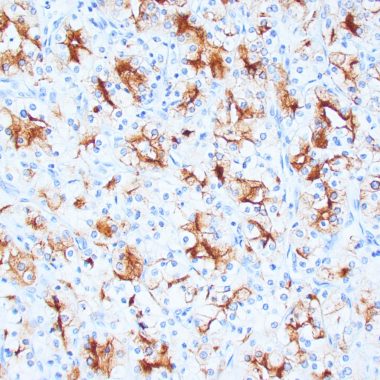

Anti-RCC antibody [66.4.C2] (STJ180234)
SPECIFICATIONS
ClonalityMonoclonal
HostMouse
ConjugationUnconjugated
IsotypeIgG2ak
ImmunogenNative from human renal cortical tissue homogenate
General Information
| Short Description | Mouse monoclonal RCC antibody for use in IHC-P in human samples. Datasheet included with dilution recommendations, and related reagents. |
| Applications | IHC-P |
| Host | Mouse |
| Reactivity | Human |
| Note | STRICTLY FOR FURTHER SCIENTIFIC RESEARCH USE ONLY (RUO). MUST NOT TO BE USED IN DIAGNOSTIC OR THERAPEUTIC APPLICATIONS. |
Product Properties
| Clonality | Monoclonal |
| Clone ID | 66.4.C2 |
| Isotype | IgG2ak |
| Conjugation | Unconjugated |
| Purification | Affinity purified |
| Dilution Range | 1:100‐200 |
| Formulation | Tris-HCI buffer containing stabilizing protein (BSA) and <0.1% ProClin |
| Storage Instruction | Store at 2‐8°C for up to 24 months. Predilute: Ready to use, no reconstitution necessary. Concentrate: Use dilution range and appropriate lab‐standardized diluent. Stability after dilution: 7 days at 24°C, 3 months at 2‐8°C, 6months at ‐20°C. |
Target Information
| Immunogen | Native from human renal cortical tissue homogenate |
| Specificity | Positive control: Normal kidney or renal cell carcinoma |
Additional Info
| Background | In normal kidney, gp200 is localized along the brush border of the pars convoluta and pars recta segments of the proximal tubule, as well as focally along the luminal surface of Bowman s capsule adjoining the outgoing proximal tubule. Of other normal tissues examined, the gp200 is also localized along the luminal surfaces of breast lobules and ducts, the luminal surface of the epididymal tubular epithelium, within the cytoplasm of parathyroid parenchymal cells, and focally within the colloid of thyroid follicles. Thirty-one other normal tissues do not express similar or cross-reacting antigens. Reportedly, gp200 is expressed by 93% of primary and 84% of metastatic renal cell carcinomas. 66.4.C2 may be a useful reagent in the investigations of carcinomas of proximal nephrogenic differentiation especially those showing tubular differentiation. |
Information sourced from Uniprot.org