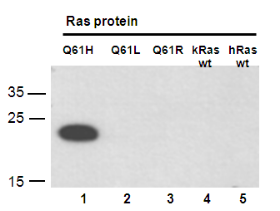
| Short Description : | Mouse monoclonal anti-Ras-A146P Mutant for use in WB, ICC, IF and ELISA in Vertebrates samples. Datasheet included with dilution recommendations, and related reagents. |
| Applications: | WB/ICC/IF/ELISA |
| Host: | Mouse |
| Reactivity: | Vertebrates |
| Note: | STRICTLY FOR FURTHER SCIENTIFIC RESEARCH USE ONLY (RUO). MUST NOT TO BE USED IN DIAGNOSTIC OR THERAPEUTIC APPLICATIONS. |
| Clonality : | Monoclonal |
| Isotype: | IgG |
| Conjugation: | Unconjugated |
| Purification: | Purified from ascites |
| Dilution Range: | WB-1:500-1:1000IHC-P-1:50-1:100ELISA-1:1000-1:500IF-1:50-1:200 |
| Formulation: | Liquid in PBS (without Mg2+ and Ca2+) , pH 7.4, 150 mM NaCl, 50% glycerol |
| Storage Instruction: | Store at-20°C. Avoid freeze/thaw cycles. |
| Immunogen: | A synthetic peptide from the internal region of Ras which includes the mutation of A146P, human origin. |
| Background | The A146P mutation of KRas results in an amino acid substitution at position 146, from an alanine to a threonine. KRAS encodes a protein that is a member of the small GTPase superfamily. Ras A146P mutation results in decreased GTPase activity and constitutive signaling. It can be found in many tumors, such as lung adenocarcinoma, mucinous adenoma, ductal carcinoma of the pancreas and colorectal carcinoma. |
Information sourced from Uniprot.org