



Anti-PTP1B antibody (C-Term) [M234] (STJA0041316)
SPECIFICATIONS
ClonalityMonoclonal
HostMouse
ConjugationUnconjugated
IsotypeIgG2a
ImmunogenClone M234 was generated from a recombinant protein corresponding to amino acids in the C-terminal region of human PTP1B.
General Information
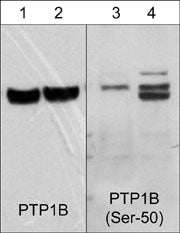
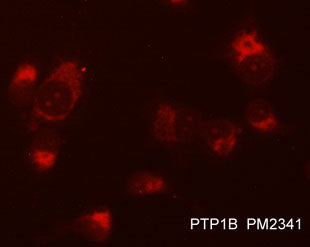
| Short Description | Mouse monoclonal anti-PTP1B (C-Term) for use in ELISA, WB and ICC in Human samples. Datasheet included with dilution recommendations, and related reagents. |
| Applications | ELISA/WB/ICC |
| Host | Mouse |
| Reactivity | Human |
| Note | STRICTLY FOR FURTHER SCIENTIFIC RESEARCH USE ONLY (RUO). MUST NOT TO BE USED IN DIAGNOSTIC OR THERAPEUTIC APPLICATIONS. |
Product Properties
| Clonality | Monoclonal |
| Clone ID | M234 |
| Isotype | IgG2a |
| Conjugation | Unconjugated |
| Purification | Protein A Purified |
| Dilution Range | WB 1:1000ICC 1:100 |
| Formulation | PBS + 1 mg/ml BSA, 0.05% NaN3 and 50% glycerol |
| Storage Instruction | Storage at-20°C is recommended, as aliquots may be taken without freeze/thawing due to presence of 50% glycerol. Stable for at least 1 year at-20°C. |
Target Information
| Gene Symbol | PTPN1 |
| Gene ID | 5770 |
| Uniprot ID | PTN1_HUMAN |
| Immunogen | Clone M234 was generated from a recombinant protein corresponding to amino acids in the C-terminal region of human PTP1B. |
| Immunogen Region | C-Term |
| Immunogen Sequence | Human |
| Specificity | This antibody detects a 50 kDa* band corresponding to PTP1B in western blots of human A431, Jurkat, and HeLa cells. It does not detect PTP1B in rat PC12 or mouse SYF cells. |
Additional Info
| Tissue Specificity | Expressed in keratinocytes (at protein level). |
| Post Translational Modifications | Oxidized on Cys-215.the Cys-SOH formed in response to redox signaling reacts with the alpha-amido of the following residue to form a sulfenamide cross-link, triggering a conformational change that inhibits substrate binding and activity. The active site can be restored by reduction. Ser-50 is the major site of phosphorylation as compared to Ser-242 and Ser-243. Activated by phosphorylation at Ser-50. S-nitrosylation of Cys-215 inactivates the enzyme activity. Sulfhydration at Cys-215 following endoplasmic reticulum stress inactivates the enzyme activity, promoting EIF2AK3/PERK activity. |
| Function | Tyrosine-protein phosphatase which acts as a regulator of endoplasmic reticulum unfolded protein response. Mediates dephosphorylation of EIF2AK3/PERK.inactivating the protein kinase activity of EIF2AK3/PERK. May play an important role in CKII- and p60c-src-induced signal transduction cascades. May regulate the EFNA5-EPHA3 signaling pathway which modulates cell reorganization and cell-cell repulsion. May also regulate the hepatocyte growth factor receptor signaling pathway through dephosphorylation of MET. |
| Protein Name | Tyrosine-Protein Phosphatase Non-Receptor Type 1Protein-Tyrosine Phosphatase 1bPtp-1b |
| Database Links | Reactome: R-HSA-354192Reactome: R-HSA-6807004Reactome: R-HSA-77387Reactome: R-HSA-877312Reactome: R-HSA-8849472Reactome: R-HSA-9022699Reactome: R-HSA-912694Reactome: R-HSA-982772Reactome: R-HSA-9860927 |
| Cellular Localisation | Endoplasmic Reticulum MembranePeripheral Membrane ProteinCytoplasmic SideInteracts With Epha3 At The Cell Membrane |
| Alternative Antibody Names | Anti-Tyrosine-Protein Phosphatase Non-Receptor Type 1 antibodyAnti-Protein-Tyrosine Phosphatase 1b antibodyAnti-Ptp-1b antibodyAnti-PTPN1 antibodyAnti-PTP1B antibody |
Information sourced from Uniprot.org