

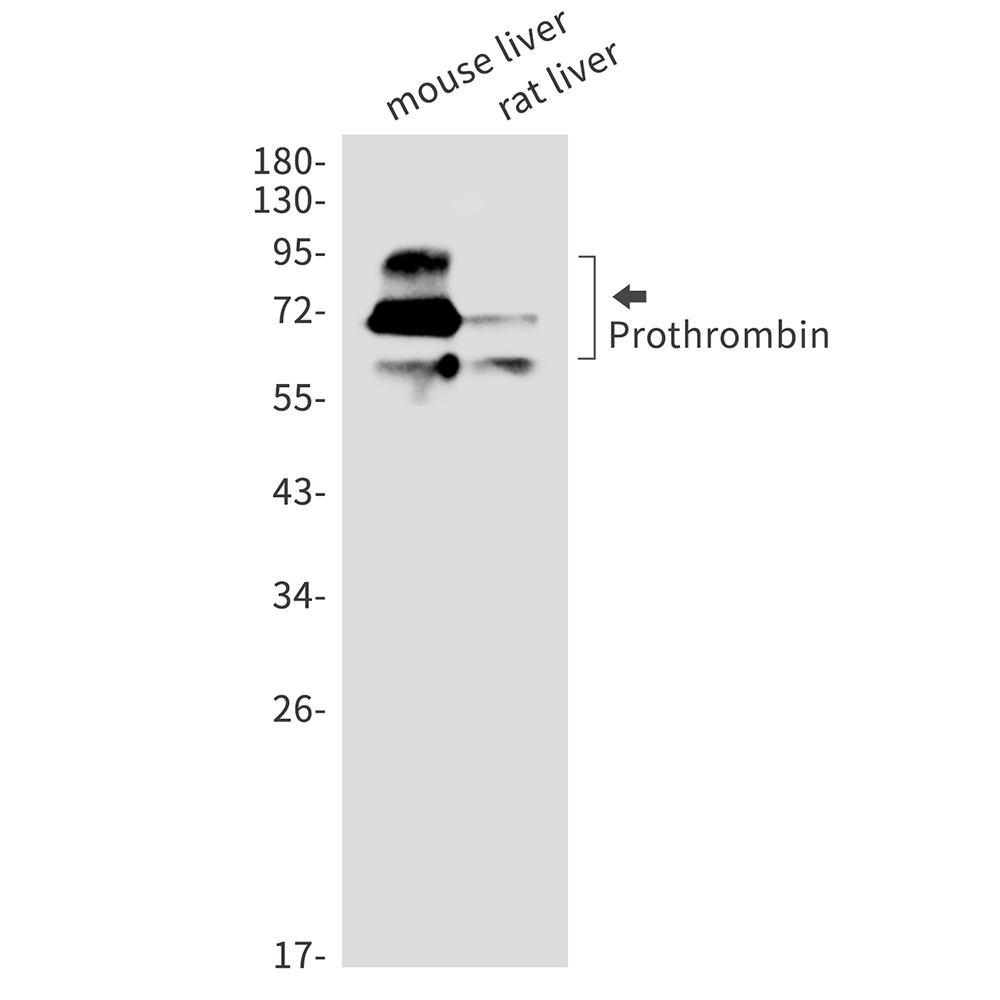

Anti-Prothrombin antibody [R08-5G1] (STJA0034762)
SPECIFICATIONS
ClonalityMonoclonal
HostRabbit
ConjugationUnconjugated
IsotypeIgG
ImmunogenRecombinant protein of mouse Prothrombin
General Information
| Short Description | Rabbit monoclonal anti-Prothrombin for use in WB and IHC-P in Mouse and Rat samples. Datasheet included with dilution recommendations, and related reagents. |
| Applications | WB/IHC-P |
| Host | Rabbit |
| Reactivity | Mouse/Rat |
| Note | STRICTLY FOR FURTHER SCIENTIFIC RESEARCH USE ONLY (RUO). MUST NOT TO BE USED IN DIAGNOSTIC OR THERAPEUTIC APPLICATIONS. |
Product Properties
| Clonality | Monoclonal |
| Clone ID | R08-5G1 |
| Isotype | IgG |
| Conjugation | Unconjugated |
| Concentration | 0.3 mg/mL |
| Purification | Affinity Purified |
| Dilution Range | WB 1:500-1:1000IHC 1:50-1:100 |
| Formulation | 50mM Tris-Glycine (pH 7.4) , 0.15M NaCl, 40% Glycerol, 0.01% Sodium azide and 0.05% BSA |
| Storage Instruction | Store at 4°C short term. Aliquot and store at-20°C long term. Avoid freeze/thaw cycles. |
Target Information
| Gene Symbol | F2 |
| Gene ID | 14061 |
| Uniprot ID | THRB_MOUSE |
| Immunogen | Recombinant protein of mouse Prothrombin |
Additional Info
| Post Translational Modifications | The gamma-carboxyglutamyl residues, which bind calcium ions, result from the carboxylation of glutamyl residues by a microsomal enzyme, the vitamin K-dependent carboxylase. The modified residues are necessary for the calcium-dependent interaction with a negatively charged phospholipid surface, which is essential for the conversion of prothrombin to thrombin. In the penultimate step of the coagulation cascade, prothrombin is converted to thrombin by the prothrombinase complex composed of factor Xa (F10), cofactor Va (F5), and phospholipids. This activation requires factor Xa-catalyzed sequential cleavage at 2 sites, Arg-311 and Arg-360, along 2 possible pathways. In the first pathway, the first cleavage occurs at Arg-311, leading to the formation of the inactive intermediate prethrombin-2. This pathway preferentially occurs on platelets and in the absence of cofactor Va. In the second pathway, the first cleavage occurs at Arg-360, which separates protease domain into 2 chains that remain connected through a disulfide bond and generates the active intermediate meizothrombin. The presence of cofactor Va directs activation along the meizothrombin pathway and greatly accelerates the rate of cleavage at Arg-360, but has a smaller effect on the cleavage of meizothrombin at Arg-311. Meizothrombin accumulates as an intermediate when prothrombinase is assembled on the membrane of red blood cells. |
| Function | Thrombin, which cleaves bonds after Arg and Lys, converts fibrinogen to fibrin and activates factors V, VII, VIII, XIII, and, in complex with thrombomodulin, protein C. Functions in blood homeostasis, inflammation and wound healing. Activates coagulation factor XI (F11).activation is promoted by the contact with negatively charged surfaces. Triggers the production of pro-inflammatory cytokines, such as MCP-1/CCL2 and IL8/CXCL8, in endothelial cells. |
| Protein Name | ProthrombinCoagulation Factor Ii Cleaved Into - Activation Peptide Fragment 1 - Activation Peptide Fragment 2 - Thrombin Light Chain - Thrombin Heavy Chain |
| Database Links | Reactome: R-MMU-140837Reactome: -MMU-140875Reactome: -MMU-159740Reactome: -MMU-159763Reactome: -MMU-159782Reactome: -MMU-202733Reactome: -MMU-375276Reactome: -MMU-416476Reactome: -MMU-456926Reactome: -MMU-76009Reactome: -MMU-977606 |
| Cellular Localisation | |
| Alternative Antibody Names | Anti-Prothrombin antibodyAnti-Coagulation Factor Ii Cleaved Into - Activation Peptide Fragment 1 - Activation Peptide Fragment 2 - Thrombin Light Chain - Thrombin Heavy Chain antibodyAnti-F2 antibodyAnti-Cf2 antibody |
Information sourced from Uniprot.org