

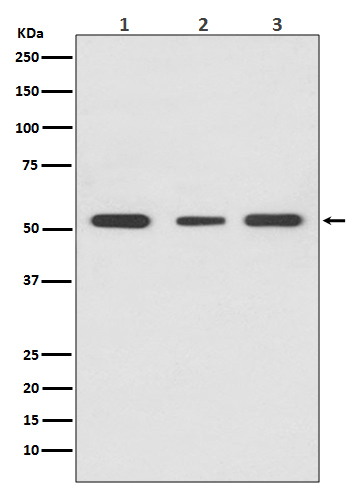

Anti-PPAR gamma antibody [R11-4O-6] (STJA0035454)
SPECIFICATIONS
ClonalityMonoclonal
HostRabbit
ConjugationUnconjugated
IsotypeIgG
ImmunogenA synthesized peptide derived from human PPAR gamma
General Information
| Short Description | Rabbit monoclonal anti-PPAR gamma for use in WB in Human samples. Datasheet included with dilution recommendations, and related reagents. |
| Applications | WB |
| Host | Rabbit |
| Reactivity | Human |
| Note | STRICTLY FOR FURTHER SCIENTIFIC RESEARCH USE ONLY (RUO). MUST NOT TO BE USED IN DIAGNOSTIC OR THERAPEUTIC APPLICATIONS. |
Product Properties
| Clonality | Monoclonal |
| Clone ID | R11-4O-6 |
| Isotype | IgG |
| Conjugation | Unconjugated |
| Purification | Affinity Chromatography |
| Dilution Range | WB 1:500-1:1000 |
| Formulation | Liquid in PBS, pH 7.4, 150mM NaCl, 0.02% sodium azide and 50% glycerol. |
| Storage Instruction | Store at 4°C short term. Aliquot and store at-20°C long term. Avoid freeze/thaw cycles. |
Target Information
| Gene Symbol | PPARG |
| Gene ID | 5468 |
| Uniprot ID | PPARG_HUMAN |
| Immunogen | A synthesized peptide derived from human PPAR gamma |
Additional Info
| Tissue Specificity | Highest expression in adipose tissue. Lower in skeletal muscle, spleen, heart and liver. Also detectable in placenta, lung and ovary. |
| Post Translational Modifications | O-GlcNAcylation at Thr-84 reduces transcriptional activity in adipocytes. Phosphorylated in basal conditions and dephosphorylated when treated with the ligand. May be dephosphorylated by PPP5C. The phosphorylated form may be inactive and dephosphorylation at Ser-112 induces adipogenic activity. Ubiquitinated by E3 ubiquitin-protein ligase complex containing FBXO9.leading to proteasomal degradation. Ubiquitinated at Lys-252 by TRIM55 leading to proteasomal degradation. Ubiquitinated by E3 ubiquitin-protein ligase STUB1/CHIP.leading to proteasomal degradation. |
| Function | Nuclear receptor that binds peroxisome proliferators such as hypolipidemic drugs and fatty acids. Once activated by a ligand, the nuclear receptor binds to DNA specific PPAR response elements (PPRE) and modulates the transcription of its target genes, such as acyl-CoA oxidase. It therefore controls the peroxisomal beta-oxidation pathway of fatty acids. Key regulator of adipocyte differentiation and glucose homeostasis. ARF6 acts as a key regulator of the tissue-specific adipocyte P2 (aP2) enhancer. Acts as a critical regulator of gut homeostasis by suppressing NF-kappa-B-mediated pro-inflammatory responses. Plays a role in the regulation of cardiovascular circadian rhythms by regulating the transcription of BMAL1 in the blood vessels. (Microbial infection) Upon treatment with M.tuberculosis or its lipoprotein LpqH, phosphorylation of MAPK p38 and IL-6 production are modulated, probably via this protein. |
| Protein Name | Peroxisome Proliferator-Activated Receptor GammaPpar-GammaNuclear Receptor Subfamily 1 Group C Member 3 |
| Database Links | Reactome: R-HSA-1989781Reactome: R-HSA-381340Reactome: R-HSA-383280Reactome: R-HSA-4090294Reactome: R-HSA-8943724Reactome: R-HSA-9022707Reactome: R-HSA-9841922Reactome: R-HSA-9844594 |
| Cellular Localisation | NucleusCytoplasmRedistributed From The Nucleus To The Cytosol Through A Map2k1/Mek1-Dependent MannerNoct Enhances Its Nuclear Translocation |
| Alternative Antibody Names | Anti-Peroxisome Proliferator-Activated Receptor Gamma antibodyAnti-Ppar-Gamma antibodyAnti-Nuclear Receptor Subfamily 1 Group C Member 3 antibodyAnti-PPARG antibodyAnti-NR1C3 antibody |
Information sourced from Uniprot.org