
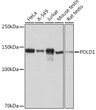


Anti-POLD1 antibody (1000-1107) [S9MR] (STJ11102019)
SPECIFICATIONS
ClonalityMonoclonal
HostRabbit
ConjugationUnconjugated
IsotypeIgG
General Information
| Short Description | Rabbit monoclonal POLD1 (1000-1107) antibody for use in WB and ELISA in human, mouse and rat samples. Datasheet included with dilution recommendations, and related reagents. |
| Applications | WB/ELISA |
| Host | Rabbit |
| Reactivity | Human/Mouse/Rat |
| Note | STRICTLY FOR FURTHER SCIENTIFIC RESEARCH USE ONLY (RUO). MUST NOT TO BE USED IN DIAGNOSTIC OR THERAPEUTIC APPLICATIONS. |
Product Properties
| Clonality | Monoclonal |
| Clone ID | S9MR |
| Isotype | IgG |
| Conjugation | Unconjugated |
| Concentration | Lot specific |
| Purification | Affinity purification |
| Dilution Range | WB:1:1000-1:6000ELISA:Recommended starting concentration is 1 Mu g/mL. Please optimize the concentration based on your specific assay requirements. |
| Formulation | PBS with 0.02% Sodium Azide, 0.05% BSA, 50% Glycerol, pH 7.3. |
| Storage Instruction | Store at-20°C for up to 1 year from the date of receipt, and avoid repeat freeze-thaw cycles. |
Target Information
| Gene Symbol | POLD1 |
| Gene ID | 5424 |
| Uniprot ID | DPOD1_HUMAN |
| Immunogen Region | 1000-1107 |
| Immunogen Sequence | GGLLAFAKRRNCCIGCRTVL SHQGAVCEFCQPRESELYQK EVSHLNALEERFSRLWTQCQ RCQGSLHEDVICTSRDCPIF YMRKKVRKDLEDQEQLLRRF GPPGPEAW |
| Specificity | A synthetic peptide corresponding to a sequence within amino acids 1000-1107 of human POLD1 (P28340). |
Additional Info
| Tissue Specificity | Widely expressed, with high levels of expression in heart and lung. |
| Function | As the catalytic component of the trimeric (Pol-delta3 complex) and tetrameric DNA polymerase delta complexes (Pol-delta4 complex), plays a crucial role in high fidelity genome replication, including in lagging strand synthesis, and repair. Exhibits both DNA polymerase and 3'- to 5'-exonuclease activities. Requires the presence of accessory proteins POLD2, POLD3 and POLD4 for full activity. Depending upon the absence (Pol-delta3) or the presence of POLD4 (Pol-delta4), displays differences in catalytic activity. Most notably, expresses higher proofreading activity in the context of Pol-delta3 compared with that of Pol-delta4. Although both Pol-delta3 and Pol-delta4 process Okazaki fragments in vitro, Pol-delta3 may be better suited to fulfill this task, exhibiting near-absence of strand displacement activity compared to Pol-delta4 and stalling on encounter with the 5'-blocking oligonucleotides. Pol-delta3 idling process may avoid the formation of a gap, while maintaining a nick that can be readily ligated. Along with DNA polymerase kappa, DNA polymerase delta carries out approximately half of nucleotide excision repair (NER) synthesis following UV irradiation. Under conditions of DNA replication stress, in the presence of POLD3 and POLD4, may catalyze the repair of broken replication forks through break-induced replication (BIR). Involved in the translesion synthesis (TLS) of templates carrying O6-methylguanine, 8oxoG or abasic sites. |
| Protein Name | Dna Polymerase Delta Catalytic Subunit3'-5' ExodeoxyribonucleaseDna Polymerase Subunit Delta P125 |
| Database Links | Reactome: R-HSA-110314Reactome: R-HSA-174411Reactome: R-HSA-174414Reactome: R-HSA-174417Reactome: R-HSA-174437Reactome: R-HSA-2564830Reactome: R-HSA-5358565Reactome: R-HSA-5358606Reactome: R-HSA-5651801Reactome: R-HSA-5656169Reactome: R-HSA-5685942Reactome: R-HSA-5696397Reactome: R-HSA-5696400Reactome: R-HSA-6782135Reactome: R-HSA-6782210Reactome: R-HSA-69091Reactome: R-HSA-69166Reactome: R-HSA-69183 |
| Cellular Localisation | NucleusColocalizes With Pcna And Pold3 At S Phase Replication SitesAfter Uv IrradiationRecruited To Dna Damage Sites Within 2 HoursIndependently On The Cell Cycle PhaseNor On Pcna UbiquitinationThis Recruitment Requires Pold3Pcna And Rfc1-Replication Factor C Complex |
| Alternative Antibody Names | Anti-Dna Polymerase Delta Catalytic Subunit antibodyAnti-3'-5' Exodeoxyribonuclease antibodyAnti-Dna Polymerase Subunit Delta P125 antibodyAnti-POLD1 antibodyAnti-POLD antibody |
Information sourced from Uniprot.org