

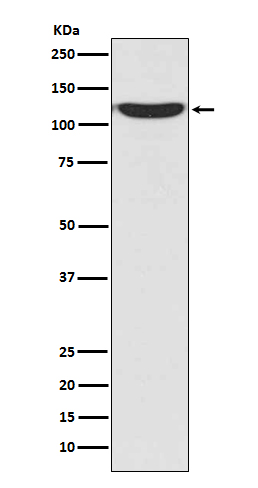

Anti-PKN2 antibody [R02-5K8] (STJA0035758)
SPECIFICATIONS
ClonalityMonoclonal
HostRabbit
ConjugationUnconjugated
IsotypeIgG
ImmunogenA synthesized peptide derived from human PKN2
General Information
| Short Description | Rabbit monoclonal anti-PKN2 for use in WB, IHC-P, ICC, IF, IP and FC in Human, Mouse and Rat samples. Datasheet included with dilution recommendations, and related reagents. |
| Applications | WB/IHC-P/ICC/IF/IP/FC |
| Host | Rabbit |
| Reactivity | Human/Mouse/Rat |
| Note | STRICTLY FOR FURTHER SCIENTIFIC RESEARCH USE ONLY (RUO). MUST NOT TO BE USED IN DIAGNOSTIC OR THERAPEUTIC APPLICATIONS. |
Product Properties
| Clonality | Monoclonal |
| Clone ID | R02-5K8 |
| Isotype | IgG |
| Conjugation | Unconjugated |
| Purification | Affinity Chromatography |
| Dilution Range | WB 1:500-1:1000IHC 1:50-1:100IF 1:50-1:200IP 1:50FC 1:50-1:100 |
| Formulation | Rabbit IgG in phosphate buffered saline, pH 7.4, 150mM NaCl, 0.02% sodium azide and 50% glycerol. |
| Storage Instruction | Store at 4°C short term. Aliquot and store at-20°C long term. Avoid freeze/thaw cycles. |
Target Information
| Gene Symbol | PKN2 |
| Gene ID | 5586 |
| Uniprot ID | PKN2_HUMAN |
| Immunogen | A synthesized peptide derived from human PKN2 |
Additional Info
| Tissue Specificity | Ubiquitous. Expressed in numerous tumor cell lines, especially in bladder tumor cells. |
| Post Translational Modifications | Autophosphorylated. Phosphorylated during mitosis. Phosphorylated by CDK10. Activated by limited proteolysis with trypsin. Proteolytically cleaved by caspase-3 during the induction of apoptotic cell death. |
| Function | PKC-related serine/threonine-protein kinase and Rho/Rac effector protein that participates in specific signal transduction responses in the cell. Plays a role in the regulation of cell cycle progression, actin cytoskeleton assembly, cell migration, cell adhesion, tumor cell invasion and transcription activation signaling processes. Phosphorylates CTTN in hyaluronan-induced astrocytes and hence decreases CTTN ability to associate with filamentous actin. Phosphorylates HDAC5, therefore lead to impair HDAC5 import. Direct RhoA target required for the regulation of the maturation of primordial junctions into apical junction formation in bronchial epithelial cells. Required for G2/M phases of the cell cycle progression and abscission during cytokinesis in a ECT2-dependent manner. Stimulates FYN kinase activity that is required for establishment of skin cell-cell adhesion during keratinocytes differentiation. Regulates epithelial bladder cells speed and direction of movement during cell migration and tumor cell invasion. Inhibits Akt pro-survival-induced kinase activity. Mediates Rho protein-induced transcriptional activation via the c-fos serum response factor (SRF). Involved in the negative regulation of ciliogenesis. (Microbial infection) Phosphorylates HCV NS5B leading to stimulation of HCV RNA replication. |
| Protein Name | Serine/Threonine-Protein Kinase N2Pkn GammaProtein Kinase C-Like 2Protein-Kinase C-Related Kinase 2 |
| Database Links | Reactome: R-HSA-5625740Reactome: R-HSA-8980692Reactome: R-HSA-9013026Reactome: R-HSA-9013106Reactome: R-HSA-9013149Reactome: R-HSA-9856530 |
| Cellular Localisation | CytoplasmNucleusMembraneCell ProjectionLamellipodiumCytoskeletonCleavage FurrowMidbodyCell JunctionColocalizes With Ptpn13 In Lamellipodia-Like StructuresRegions Of Large Actin TurnoverAccumulates During Telophase At The Cleavage Furrow And Concentrates Finally Around The Midbody In CytokinesisRecruited To Nascent Cell-Cell Contacts At The Apical Surface Of CellsIn The Course Of Viral InfectionColocalizes With Hcv Ns5b At Perinuclear Region In The Cytoplasm |
| Alternative Antibody Names | Anti-Serine/Threonine-Protein Kinase N2 antibodyAnti-Pkn Gamma antibodyAnti-Protein Kinase C-Like 2 antibodyAnti-Protein-Kinase C-Related Kinase 2 antibodyAnti-PKN2 antibodyAnti-PRK2 antibodyAnti-PRKCL2 antibody |
Information sourced from Uniprot.org