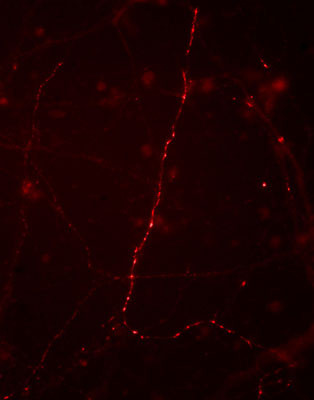
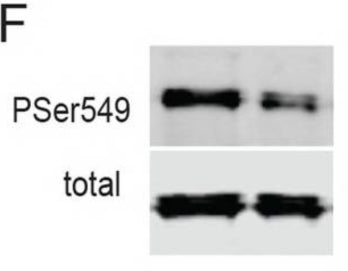
| Short Description : | Rabbit polyclonal anti-Phospho-Synapsin-Ser549 for use in WB and ICC in Mouse, Rat, Bovine, Canine, Human and Non-Human Primates samples. Datasheet included with dilution recommendations, and related reagents. |
| Applications: | WB/ICC |
| Host: | Rabbit |
| Reactivity: | Mouse/Rat/Bovine/Canine/Human/Non-Human Primates |
| Note: | STRICTLY FOR FURTHER SCIENTIFIC RESEARCH USE ONLY (RUO). MUST NOT TO BE USED IN DIAGNOSTIC OR THERAPEUTIC APPLICATIONS. |
| Clonality : | Polyclonal |
| Isotype: | IgG |
| Conjugation: | Unconjugated |
| Purification: | This antibody was antigen affinity purified from pooled serum. |
| Dilution Range: | WB 1:1000ICC 1:500 |
| Formulation: | 100 µl in 10 mM HEPES (pH 7.5) , 150 mM NaCl, 100 µg per ml BSA and 50% Glycerol. |
| Storage Instruction: | Store at-20°C for up to 1 year from the date of receipt, and avoid repeat freeze-thaw cycles. |
| Immunogen: | Synthetic phospho-peptide corresponding to amino acid residues surrounding Ser549 conjugated to KLH. |
| Background | Synapsin I plays a key role in synaptic plasticity in brain (Feng et al., 2002; Nayak et al., 1996). This effect is due in large part to the ability of the synapsins to regulate the availability of synaptic vesicles for release. The role of synapsin in synaptic plasticity and in synaptogensis is regulated by 549 phosphorylation (Jovanovic et al., 2001; Kao et al., 2002). Ser 62 67 along with Ser and Ser are the sites of synapsin I that are phosphorylated by MAP kinase (Jovanovic et al., 1996). Phosphorylation and subsequent dephosphorylation of this site is thought to play a key role in synaptic vesicle trafficking. |
Information sourced from Uniprot.org